Unit 3: Work, Energy, & Power第 3 单元:功、能量与功率
Conservation as a foundational principle of physics, with work as the primary agent of change for energy. Master scalar quantities, calculus-based work and potential-energy relations, and the graphical techniques of this unit.守恒(conservation)是物理学最根本的原则之一,而功(work)是改变能量的主要途径。掌握标量、基于微积分的功与势能关系,以及本单元的图像分析技巧。
Conservation as a foundational principle of physics, with work as the primary agent of change for energy. Master scalar quantities, energy bar charts, and algebra-based graph reading (slopes and areas).守恒(conservation)是物理学最根本的原则之一,而功(work)是改变能量的主要途径。掌握标量、能量条形图(energy bar chart)以及以代数为基础的图像分析(斜率与面积)。
Translational Kinetic Energy平动动能
- Calculate translational kinetic energy $K = \tfrac{1}{2}mv^2$ in joules from mass and speed.
- Explain why kinetic energy is a scalar that is never negative.
- Predict how $K$ changes when mass or speed is multiplied by a factor (doubling $v$ multiplies $K$ by 4).
- Explain why the value of kinetic energy depends on the reference frame.
- Calculate a change in kinetic energy $\Delta K = K_f - K_i$ and interpret its sign.
- 由质量和速率计算平动动能 $K = \tfrac{1}{2}mv^2$(单位:焦耳
J)。 - 解释(
explain)为什么动能是标量且永不为负。 - 预测质量或速率乘以某个倍数时 $K$ 如何变化($v$ 加倍,$K$ 变为 4 倍)。
- 解释为什么动能的数值依赖于参考系(
reference frame)。 - 计算动能变化 $\Delta K = K_f - K_i$ 并解释其正负号。
Kinetic energy is the energy an object possesses because it is moving. In this unit we focus on translational kinetic energy: the energy associated with an object's center-of-mass motion through space (rotational kinetic energy appears in Unit 6).
动能(kinetic energy)是物体由于运动而具有的能量。本单元重点研究平动动能(translational kinetic energy):与物体质心(center of mass)在空间中的整体运动相关联的那部分能量(转动动能将在 Unit 6 出现)。
The quantity depends on two things: mass and speed. Because velocity is squared, even modest increases in speed produce large increases in kinetic energy. Doubling the speed quadruples the kinetic energy.
动能只与两个量有关:质量与速率。由于速度是平方出现的,速率的少许增加都会带来动能的大幅上升。速率翻倍,动能变为原来的四倍。
Joule,J = kg·m²/s²)。scalar):没有方向。由于质量与速度的平方都非负,动能始终非负。两个以相同速率反向运动的物体动能相同。
reference frame)中动能为零,但在地面参考系中可能动能巨大。动能与参考系有关,尽管物理定律在所有惯性系(inertial frame)中都相同。
Around 1686 Gottfried Leibniz argued that the "living force" (vis viva) of a moving body is $mv^2$, not Descartes' $mv$. In the 1720s Willem 's Gravesande dropped brass balls into soft clay: the dent grew with the drop height, so with $v^2$.
约 1686 年,Gottfried Leibniz 提出运动物体的"活力"(vis viva)是 $mv^2$,而不是 Descartes 的 $mv$。18 世纪 20 年代,Willem 's Gravesande 把黄铜球落入软黏土:凹坑随下落高度增大,也就是随 $v^2$ 增大。
Émilie du Châtelet made the case widely known in 1740. The factor $\tfrac{1}{2}$ and the word "work" came later, from Gaspard-Gustave Coriolis in 1829.
1740 年,Émilie du Châtelet 使这一论证广为人知。系数 $\tfrac{1}{2}$ 和"功"(work)这个词更晚出现,由 Gaspard-Gustave Coriolis 在 1829 年提出。
Wikipedia: Vis viva (the mv² debate and the clay-drop evidence)维基百科:Vis viva(关于 mv² 的争论与黏土落球证据)
Worked Example: Comparing Kinetic Energies例题:动能大小比较
A 1200 kg car moves at 15 m/s. A 0.005 kg bullet moves at 900 m/s. Which has greater kinetic energy?
一辆 1200 kg 的汽车以 15 m/s 行驶,一颗 0.005 kg 的子弹以 900 m/s 飞行。哪个动能更大?
Worked Example: Change in Kinetic Energy When a Car Speeds Up例题:汽车加速时的动能变化
A 1500 kg car speeds up from 10 m/s to 20 m/s. Find its initial and final kinetic energies and the change $\Delta K$.
一辆 1500 kg 的汽车从 10 m/s 加速到 20 m/s。求其初、末动能以及动能变化 $\Delta K$。
For a ratio question, write $K \propto mv^2$ and multiply the factors (mass $\times 2$ and speed $\times \tfrac{1}{2}$ give $2 \times \tfrac{1}{4} = \tfrac{1}{2}$) instead of inventing numbers. Never give a kinetic energy a direction or a negative sign, and compute $\Delta K$ as $\tfrac{1}{2}m(v_f^2 - v_i^2)$, not $\tfrac{1}{2}m(v_f - v_i)^2$. State the answer in joules.
比值类题目先写出 $K \propto mv^2$,再把各个倍数相乘(质量 $\times 2$、速率 $\times \tfrac{1}{2}$ 得到 $2 \times \tfrac{1}{4} = \tfrac{1}{2}$),不要自己编数字代入。动能永远不带方向,也不会为负;$\Delta K$ 要按 $\tfrac{1}{2}m(v_f^2 - v_i^2)$ 计算,而不是 $\tfrac{1}{2}m(v_f - v_i)^2$。答案以焦耳(J)为单位。
Can kinetic energy be negative? Can a change in kinetic energy be negative?动能可以为负吗?动能的变化可以为负吗?
Kinetic energy cannot be negative, because mass is positive and $v^2 \geq 0$. A change in kinetic energy can be negative: $\Delta K < 0$ whenever the object slows down, for example a car braking to a stop.
动能不可能为负,因为质量为正且 $v^2 \geq 0$。动能的变化可以为负:物体减速时 $\Delta K < 0$,例如汽车刹车停下。
A cart has $20\;\text{J}$ of kinetic energy. Its speed is tripled. What is its new kinetic energy?一辆小车的动能为 $20\;\text{J}$。其速率变为原来的 3 倍,新的动能是多少?
$K \propto v^2$, so tripling $v$ multiplies $K$ by $3^2 = 9$: $K_f = 9 \times 20 = 180\;\text{J}$.
$K \propto v^2$,速率 $v$ 变为 3 倍时 $K$ 乘以 $3^2 = 9$:$K_f = 9 \times 20 = 180\;\text{J}$。
A 4000 kg truck moves at 10 m/s. How fast must a 1000 kg car move to have the same kinetic energy?一辆 4000 kg 的卡车以 10 m/s 行驶。1000 kg 的轿车要以多大速率行驶,动能才与卡车相同?
Truck: $K = \tfrac{1}{2}(4000)(10)^2 = 2.0\times 10^{5}\;\text{J}$. Car: $v = \sqrt{2K/m} = \sqrt{2(2.0\times 10^{5})/1000} = \sqrt{400} = 20\;\text{m/s}$. A quarter of the mass needs twice the speed, because $K \propto mv^2$.
卡车:$K = \tfrac{1}{2}(4000)(10)^2 = 2.0\times 10^{5}\;\text{J}$。轿车:$v = \sqrt{2K/m} = \sqrt{2(2.0\times 10^{5})/1000} = \sqrt{400} = 20\;\text{m/s}$。质量为四分之一时速率需要加倍,因为 $K \propto mv^2$。
Work功
- Calculate the work done by a constant force with $W = Fd\cos\theta$ and state when it is positive, negative or zero.
- Calculate work as the area under a force-position graph, counting area below the axis as negative work.
- Apply the work-energy theorem $W_\text{net} = \Delta K$ to find a speed.
- Distinguish conservative from nonconservative forces by whether their work depends on the path.
- Calculate the work done by a position-dependent force with $W = \int F(x)\,dx$ and derive the work-energy theorem from Newton's second law.
- 用 $W = Fd\cos\theta$ 计算恒力做功,并说明(
state)何时为正、为负或为零。 - 把功计算为力-位置图像下的面积,横轴以下的面积记为负功。
- 应用动能定理 $W_\text{net} = \Delta K$ 求速率。
- 根据做功是否与路径有关,区分保守力(
conservative force)与非保守力。 - 用 $W = \int F(x)\,dx$ 计算随位置变化的力所做的功,并由 Newton 第二定律推导动能定理。
Work is the mechanism by which energy is transferred into or out of a system by a force acting over a displacement. Forces cause accelerations (Unit 2), but they also cause energy changes, and work is the bridge between force and energy.
功(work)是力沿位移作用时,能量进入或离开系统的机制。力会引起加速度(见 Unit 2),但同时也引起能量变化,而功正是连接力与能量的桥梁。
Work is a scalar quantity. It can be positive (energy flows into the system), negative (energy flows out), or zero (no energy transfer). The sign depends on the angle between the force and displacement.
功是标量。可以为正(能量流入系统)、为负(能量流出),也可以为零(无能量传递)。正负号由力与位移之间的夹角决定。
The Dot Product and Constant-Force Work标量积与恒力做功
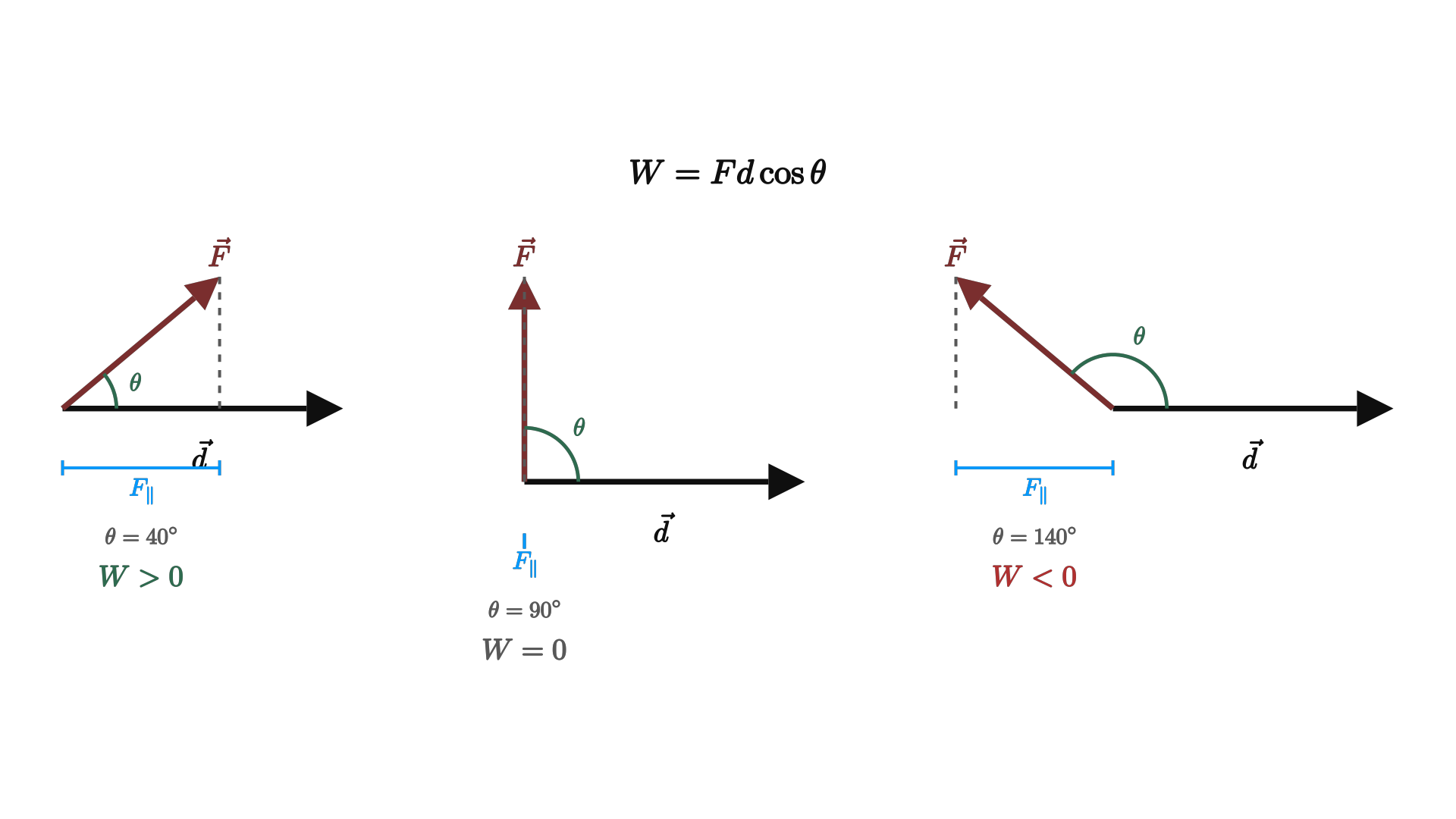
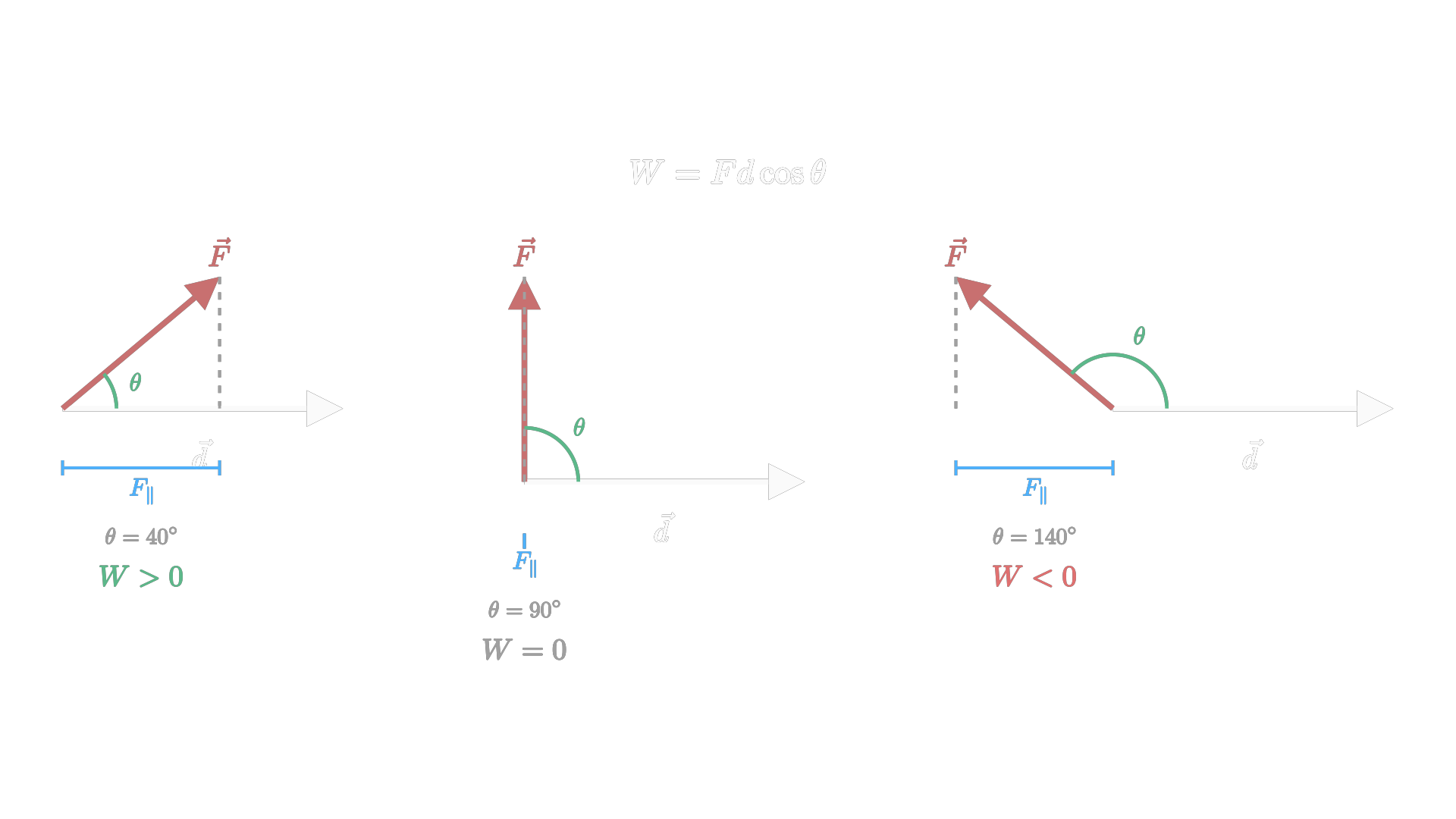
When a constant force $\vec{F}$ acts on an object undergoing displacement $\vec{d}$, the work done is the dot product of the two vectors. Only the component of force parallel to the displacement transfers energy. The perpendicular component changes direction without changing speed; think of centripetal force in circular motion.
当恒力 $\vec{F}$ 作用于发生位移 $\vec{d}$ 的物体时,所做的功就是两个矢量的标量积(dot product,又称点积)。只有与位移平行的分量传递能量;垂直分量只改变方向、不改变速率:想想圆周运动中的向心力(centripetal force)。
positive work)。当 $\theta = 90°$:力垂直于位移 → $W = 0$。当 $\theta > 90°$:力与位移方向相反 → $W < 0$(负功,negative work)。这正是余弦函数的行为。
Work by a Variable Force: Integration变力做功:积分 Physics C
Work from the Area Under a Force-Position Graph由力-位置图像下的面积求功
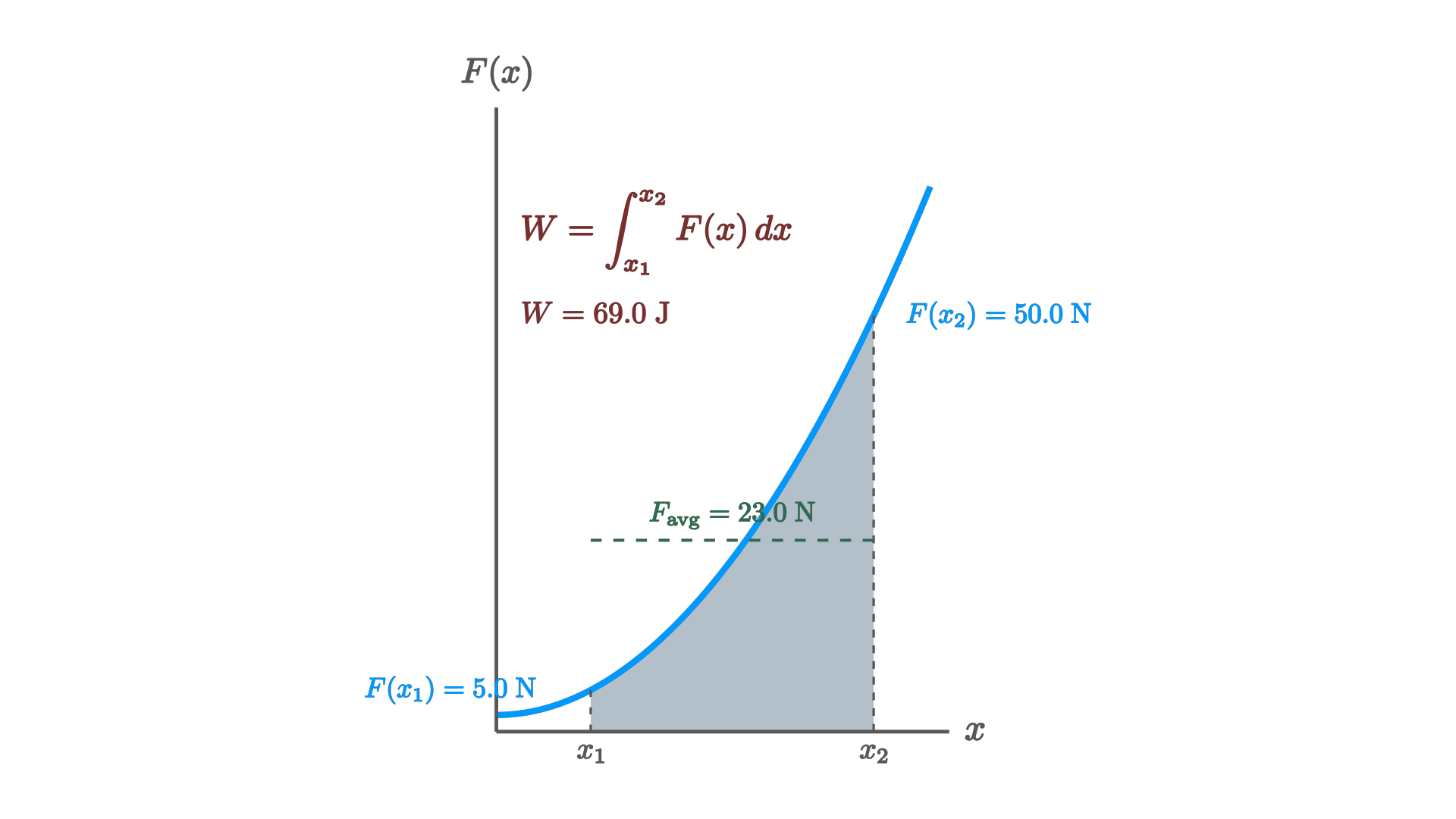
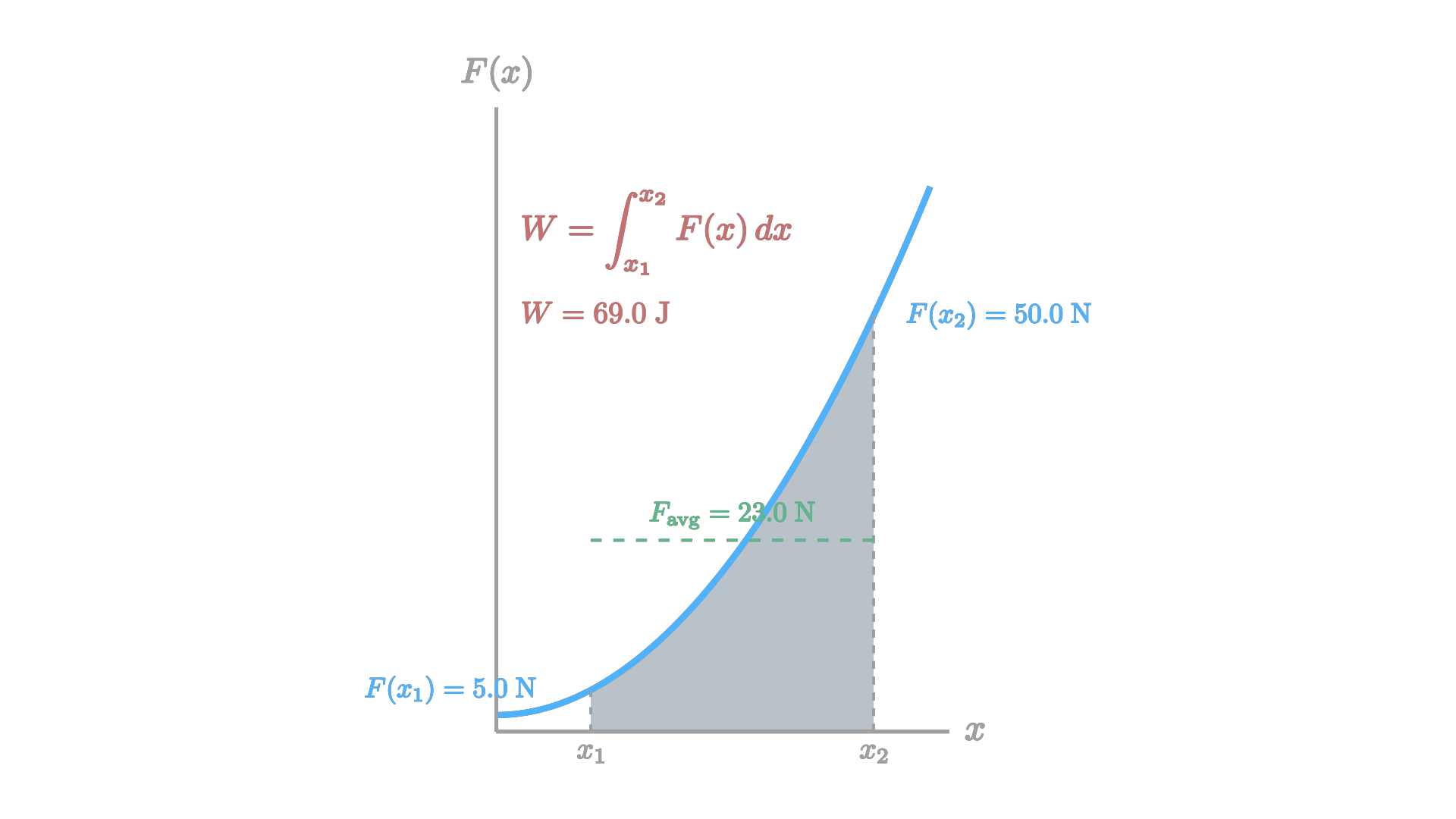
In AP Physics C, forces are often not constant: springs, gravity at large distances, and many applied forces vary with position. When force depends on position, we must integrate along the path. This is one of the signature calculus applications in the course.
在 AP Physics C 中,力往往不是恒定的:弹簧力、远距离的引力以及许多外加力都会随位置变化。当力依赖于位置时,必须沿路径做积分(integral)。这是本课程最具标志性的微积分应用之一。
Many forces are not constant: a spring pulls harder the further it is stretched. When the force changes with position, $W = Fd\cos\theta$ cannot be applied to the whole motion at once. Instead, plot the force component along the motion, $F_\parallel$, against position $x$.
许多力并不恒定:弹簧被拉得越长,拉力越大。当力随位置变化时,不能对整个过程直接套用 $W = Fd\cos\theta$。应把沿运动方向的力分量 $F_\parallel$ 对位置 $x$ 作图:
The work is the area between the graph and the $x$-axis: area above the axis is positive work, area below it is negative work. For straight-line graphs, split the region into rectangles and triangles and add their areas.
功等于图线与 $x$ 轴之间的面积(area under the graph),横轴以上为正功,横轴以下为负功。图线由直线段组成时,把区域分成矩形和三角形,再把面积相加。
elastic potential energy)的形式储存在弹簧中。Worked Example: Work Done by a Position-Dependent Force例题:位置相关的变力做功 Physics C
A force $F(x) = 3x^2 + 2$ (N) is applied as an object moves from $x = 1$ m to $x = 4$ m. Find the work done.
物体在 $x = 1$ m 到 $x = 4$ m 之间运动时受到力 $F(x) = 3x^2 + 2$(N)。求所做的功。
Worked Example: Work from a Force-Position Graph例题:由力-位置图像求功
A 2.0 kg cart starts from rest on a frictionless track. The force pushing it along the track rises steadily from 0 to 8.0 N between $x = 0$ and $x = 2.0$ m, stays at 8.0 N from $x = 2.0$ m to $x = 5.0$ m, then falls steadily to 0 at $x = 6.0$ m. Find the work done and the cart's speed at $x = 6.0$ m.
质量 2.0 kg 的小车在无摩擦轨道上从静止开始运动。沿轨道推动它的力在 $x = 0$ 到 $x = 2.0$ m 间从 0 均匀增大到 8.0 N,在 $x = 2.0$ m 到 $x = 5.0$ m 间保持 8.0 N,然后在 $x = 6.0$ m 处均匀减小到 0。求所做的功以及小车在 $x = 6.0$ m 处的速率。
Worked Example: Block on a Rough Incline (Energy Method)例题:粗糙斜面上的滑块(能量方法)
A 3.0 kg block slides 4.0 m down a 30° incline starting from rest. The kinetic friction coefficient is $\mu_k = 0.20$. Find the speed at the bottom using the work–energy theorem.
一个 3.0 kg 的滑块从静止开始沿 30° 斜面下滑 4.0 m,动摩擦系数(coefficient of kinetic friction)$\mu_k = 0.20$。用动能定理(work–energy theorem)求其抵达底端时的速率。
The Work–Energy Theorem动能定理
The net work done on an object (by all forces combined) equals the change in that object's kinetic energy. This exact theorem is derivable from Newton's second law via calculus and gives you a powerful alternative to $\vec{F} = m\vec{a}$ for solving problems.
作用在物体上的所有力共同所做的净功等于该物体动能的变化。这条精确定理(work–energy theorem)可由 Newton 第二定律通过微积分推出,是 $\vec{F} = m\vec{a}$ 之外的一种强有力解题工具。
The net work done on an object (by all forces combined) equals the change in that object's kinetic energy. For a constant net force it follows from Newton's second law: multiply $v_f^2 = v_i^2 + 2ad$ by $\tfrac{1}{2}m$ and use $F_\text{net} = ma$ to get $F_\text{net}\,d = \tfrac{1}{2}mv_f^2 - \tfrac{1}{2}mv_i^2$. It gives you a powerful alternative to $\vec{F} = m\vec{a}$ for solving problems.
作用在物体上的所有力共同所做的净功等于该物体动能的变化(动能定理,work-energy theorem)。合力恒定时,它可由 Newton 第二定律得到:把 $v_f^2 = v_i^2 + 2ad$ 两边乘以 $\tfrac{1}{2}m$,再用 $F_\text{net} = ma$,得到 $F_\text{net}\,d = \tfrac{1}{2}mv_f^2 - \tfrac{1}{2}mv_i^2$。它是 $\vec{F} = m\vec{a}$ 之外的一种强有力解题工具。
If a question asks you to derive the theorem, these four lines are the whole argument. Start from Newton's second law and integrate along the path.
The key trick in step 3 is treating $\frac{dv}{dt}\,dx$ as $v\,dv$. When asked to derive the theorem, write each line so the method is visible, not only the result.
如果题目要求推导这一定理,这四行就是完整的论证。从 Newton 第二定律出发,沿路径积分。
第 3 步的关键技巧是把 $\frac{dv}{dt}\,dx$ 改写为 $v\,dv$。题目要求推导(derive)时,把每一行都写出来,让方法本身可见,而不只是结果。
Work Done Against Friction克服摩擦力做功
When friction is present, the energy dissipated equals the friction force times the total path length (not displacement). This energy leaves the mechanical system as thermal energy and sound.
存在摩擦时,耗散的能量等于摩擦力乘以总路程(path length,不是位移)。这部分能量以热能(thermal energy)和声能离开机械系统。
Conservative vs. Nonconservative Forces保守力与非保守力
Conservative forces do work that depends only on starting and ending positions, not on the path taken. A round trip gives zero net work. Gravity, spring forces, and electrostatic forces are conservative. Because their work is path-independent, we can define a potential energy for each.
保守力(conservative force)所做的功只与起点和终点位置有关,与路径无关。沿闭合路径走一圈做功为零。重力、弹簧力、静电力都是保守力。正因其做功与路径无关,我们才能为每种保守力定义一个势能(potential energy)。
Nonconservative Forces and Friction非保守力与摩擦力
Nonconservative forces do path-dependent work. The most common are friction and air resistance. A box sliding back and forth loses energy on every pass: kinetic friction opposes the sliding each time, so its work on the box is negative on every pass and accumulates. You cannot define a potential energy for friction.
非保守力(nonconservative force)所做的功与路径相关,最常见的是摩擦力和空气阻力。来回滑动的木箱每往返一次都损失能量:动摩擦力每一次都与滑动方向相反,因此它对木箱做的功每次都为负,并且不断累积。摩擦力没有对应的势能。
| Property性质 | Conservative force保守力 | Nonconservative force非保守力 |
|---|---|---|
| Examples例子 | gravity, spring force, electrostatic force重力、弹簧力、静电力 | kinetic friction, air resistance动摩擦力、空气阻力 |
| Work depends on做功取决于 | start and end positions only只取决于起点和终点 | the path taken (friction: path length)所走的路径(摩擦:路程) |
| Work around a closed loop闭合路径上的功 | $W = 0$ | not zero (friction: $W = -F_f d < 0$)不为零(摩擦:$W = -F_f d < 0$) |
| Potential energy势能 | defined by $\Delta U = -W_\text{cons}$由 $\Delta U = -W_\text{cons}$ 定义 | none can be defined无法定义 |
| Effect on $K + U$对 $K + U$ 的影响 | trades $K$ and $U$; the sum is unchanged在 $K$ 与 $U$ 之间转换,总和不变 | changes it: $\Delta E_\text{mech} = W_\text{nc}$使其改变:$\Delta E_\text{mech} = W_\text{nc}$ |
In $W = Fd\cos\theta$, $\theta$ is the angle between the force and the displacement, not the angle of the incline: for gravity on a block sliding down a $30^{\circ}$ ramp, $\theta = 60^{\circ}$, so $W_g = mgd\cos 60^{\circ} = mgd\sin 30^{\circ}$.
在 $W = Fd\cos\theta$ 中,$\theta$ 是力与位移之间的夹角,而不是斜面倾角:滑块沿 $30^{\circ}$ 斜面下滑时,重力与位移的夹角 $\theta = 60^{\circ}$,所以 $W_g = mgd\cos 60^{\circ} = mgd\sin 30^{\circ}$。
List every force, give each one's work with its sign, then add; the normal force and any force perpendicular to the motion do zero work. For a force-position graph, write "work = area under the graph" and show the area calculation with units.
列出每一个力,分别写出带正负号的功,再相加;法向力以及任何垂直于运动方向的力都不做功。遇到力-位置图像时,写明"功 = 图线下面积",并带单位写出面积计算过程。
When $F$ depends on $x$, write the integral with its limits, $W = \int_{x_i}^{x_f} F(x)\,dx$, before evaluating it, so the setup is visible.
当 $F$ 随 $x$ 变化时,先写出带上下限的积分 $W = \int_{x_i}^{x_f} F(x)\,dx$ 再求值,让建模过程清晰可见。
A rope pulls a sled $8.0\;\text{m}$ along level snow with a $20\;\text{N}$ force at $40^{\circ}$ above the horizontal. How much work does the rope do?绳子以与水平方向成 $40^{\circ}$ 的 $20\;\text{N}$ 拉力,把雪橇沿水平雪面拉动 $8.0\;\text{m}$。绳子做了多少功?
$W = Fd\cos\theta = (20)(8.0)\cos 40^{\circ} = 160(0.766) \approx 123\;\text{J}$. Only the horizontal component of the pull, $20\cos 40^{\circ} \approx 15.3\;\text{N}$, lies along the displacement.
$W = Fd\cos\theta = (20)(8.0)\cos 40^{\circ} = 160(0.766) \approx 123\;\text{J}$。只有拉力的水平分量 $20\cos 40^{\circ} \approx 15.3\;\text{N}$ 沿位移方向。
A puck on a string moves in a horizontal circle at constant speed on frictionless ice. How much work does the string tension do in one revolution? Explain.冰面无摩擦,系在绳上的冰球以恒定速率做水平圆周运动。绳子张力在一圈中做功多少?请解释。
Zero. The tension points toward the center, perpendicular to the velocity at every instant, so $\cos 90^{\circ} = 0$ for every small displacement. This agrees with the work-energy theorem: the speed is constant, so $\Delta K = 0$.
零。张力始终指向圆心,每一时刻都与速度垂直,每一小段位移上都有 $\cos 90^{\circ} = 0$。这与动能定理一致:速率不变,故 $\Delta K = 0$。
A $2.0\;\text{kg}$ box moving at $3.0\;\text{m/s}$ is pushed $4.0\;\text{m}$ across a floor by a horizontal $10\;\text{N}$ force while friction of $4.0\;\text{N}$ acts. Find its final speed.一个 $2.0\;\text{kg}$ 的箱子以 $3.0\;\text{m/s}$ 运动,受 $10\;\text{N}$ 的水平推力在地面上前进 $4.0\;\text{m}$,同时受到 $4.0\;\text{N}$ 的摩擦力。求其末速率。
Net work: $W_\text{net} = (10 - 4.0)(4.0) = 24\;\text{J}$. Initial kinetic energy: $K_i = \tfrac{1}{2}(2.0)(3.0)^2 = 9.0\;\text{J}$. So $K_f = 9.0 + 24 = 33\;\text{J}$ and $v_f = \sqrt{2(33)/2.0} = \sqrt{33} \approx 5.7\;\text{m/s}$.
净功:$W_\text{net} = (10 - 4.0)(4.0) = 24\;\text{J}$。初动能:$K_i = \tfrac{1}{2}(2.0)(3.0)^2 = 9.0\;\text{J}$。所以 $K_f = 9.0 + 24 = 33\;\text{J}$,$v_f = \sqrt{2(33)/2.0} = \sqrt{33} \approx 5.7\;\text{m/s}$。
Explain, using a round trip, why kinetic friction is a nonconservative force.用往返过程解释为什么动摩擦力是非保守力。
Slide a box $d$ forward and then $d$ back to the start. Friction opposes the motion on both legs, so its work is $-f_k d$ each way and $-2f_k d$ in total, not zero. A conservative force does zero net work around any closed path, so friction is nonconservative and has no potential energy.
把箱子向前推 $d$,再向后推 $d$ 回到原处。两段中摩擦力都与运动方向相反,每段做功 $-f_k d$,总共 $-2f_k d$,不为零。保守力沿任何闭合路径做的净功为零,所以摩擦力是非保守力,没有对应的势能。
A $2.0\;\text{kg}$ cart starts from rest. A force-position graph shows $F_\parallel = +6.0\;\text{N}$ from $x = 0$ to $x = 2.0\;\text{m}$, then $F_\parallel = -3.0\;\text{N}$ from $x = 2.0\;\text{m}$ to $x = 5.0\;\text{m}$. Find the total work and the cart's speed at $x = 5.0\;\text{m}$.一辆 $2.0\;\text{kg}$ 的小车从静止开始运动。力-位置图像显示:$x = 0$ 到 $x = 2.0\;\text{m}$ 间 $F_\parallel = +6.0\;\text{N}$,$x = 2.0\;\text{m}$ 到 $x = 5.0\;\text{m}$ 间 $F_\parallel = -3.0\;\text{N}$。求总功以及小车在 $x = 5.0\;\text{m}$ 处的速率。
The area above the axis is $(6.0)(2.0) = 12\;\text{J}$ (positive work). The area below the axis is $(3.0)(3.0) = 9.0\;\text{J}$ (negative work). So $W = 12 - 9.0 = 3.0\;\text{J}$. Then $\tfrac{1}{2}(2.0)v^2 = 3.0$, so $v = \sqrt{3.0} \approx 1.7\;\text{m/s}$.
横轴上方的面积为 $(6.0)(2.0) = 12\;\text{J}$(正功),横轴下方的面积为 $(3.0)(3.0) = 9.0\;\text{J}$(负功)。所以 $W = 12 - 9.0 = 3.0\;\text{J}$。再由 $\tfrac{1}{2}(2.0)v^2 = 3.0$ 得 $v = \sqrt{3.0} \approx 1.7\;\text{m/s}$。
Potential Energy势能
- Explain why potential energy belongs to a system of interacting objects, not to one object.
- Calculate changes in gravitational ($mg\Delta y$) and elastic ($\tfrac{1}{2}kx^2$) potential energy, choosing a convenient zero.
- Relate the work done by a conservative force to the change in potential energy: $\Delta U = -W_\text{cons}$.
- Determine the direction and size of a force from the slope of a $U$-$x$ graph and identify stable and unstable equilibrium positions and turning points.
- Calculate $F_x = -dU/dx$ from a given $U(x)$ and $U$ from a force by integration, and classify equilibria with the sign of $d^2U/dx^2$.
- 解释为什么势能属于相互作用的物体系统,而不属于单个物体。
- 计算重力势能变化($mg\Delta y$)与弹性势能($\tfrac{1}{2}kx^2$),并选择方便的零势能点。
- 把保守力做的功与势能变化联系起来:$\Delta U = -W_\text{cons}$。
- 由 $U$-$x$ 图像的斜率确定(
determine)力的方向和大小,并找出稳定与不稳定平衡位置以及转折点(turning point)。 - 由给定的 $U(x)$ 计算 $F_x = -dU/dx$,由力积分得到 $U$,并用 $d^2U/dx^2$ 的符号判断平衡的稳定性。
Potential energy is the energy stored in a system by virtue of the positions or configurations of the objects within it. Unlike kinetic energy, potential energy is a property of a system of interacting objects. A ball held above the ground has gravitational PE, but that energy belongs to the ball–Earth system, not the ball alone.
势能(potential energy)是系统因其内部各物体的位置或构型而储存的能量。与动能不同,势能是一个相互作用系统的属性。被高高举起的球具有重力势能,但这部分能量属于"球-地球"系统,而不是球单独所有。
Potential energy is scalar. Its value depends on position, and the observer gets to choose where PE is zero. Only changes in PE matter physically; pick the reference that makes the math simplest.
势能是标量。其数值依赖于位置,且观察者可以自由选定零势能位置。物理上有意义的只是势能的变化:选一个能让计算最简单的参考点即可。
First Principles: Where $\tfrac{1}{2}kx^2$ Comes From第一性原理:$\tfrac{1}{2}kx^2$ 从何而来
Principle. The spring force $F_x = -kx$ is conservative, so the stored energy is the work an external agent does stretching the spring slowly from $x = 0$: $U_s = W_\text{ext}$.
原理。弹簧力 $F_x = -kx$ 是保守力,所以储存的能量等于外界从 $x = 0$ 起缓慢拉伸弹簧所做的功:$U_s = W_\text{ext}$。
- Slow stretching balances the forces: $F_\text{ext} = +kx'$ at each extension $x'$.
- Each small step $dx'$ costs $dW_\text{ext} = kx'\,dx'$.
- Add the steps from $0$ to $x$: $U_s = \displaystyle\int_0^{x} kx'\,dx' = \tfrac{1}{2}kx^2$.
- 缓慢拉伸使力平衡:在每个伸长量 $x'$ 处 $F_\text{ext} = +kx'$。
- 每一小步 $dx'$ 需要做功 $dW_\text{ext} = kx'\,dx'$。
- 把从 $0$ 到 $x$ 的各步相加:$U_s = \displaystyle\int_0^{x} kx'\,dx' = \tfrac{1}{2}kx^2$。
- Plot the external force $F_\text{ext} = kx$ against extension: a straight line through the origin.
- Work is the area under a force-position graph, so the work to reach $x$ is the triangle under that line.
- Triangle area is $\tfrac{1}{2}\times\text{base}\times\text{height} = \tfrac{1}{2}(x)(kx)$, so $U_s = \tfrac{1}{2}kx^2$.
- 以伸长量为横轴画出外力 $F_\text{ext} = kx$:一条过原点的直线。
- 功等于力-位置图像下的面积,所以拉伸到 $x$ 所做的功就是这条直线下方的三角形面积。
- 三角形面积为 $\tfrac{1}{2}\times\text{底}\times\text{高} = \tfrac{1}{2}(x)(kx)$,所以 $U_s = \tfrac{1}{2}kx^2$。
Check. The $\tfrac{1}{2}$ appears because the force grows from zero, so its average over the stretch is $\tfrac{1}{2}kx$. As $x \to 0$, $U_s \to 0$; doubling $x$ multiplies $U_s$ by 4. Units: $(\text{N/m})(\text{m}^2) = \text{N}\cdot\text{m} = \text{J}$.
检验。出现 $\tfrac{1}{2}$ 是因为力从零开始增大,整个拉伸过程的平均力为 $\tfrac{1}{2}kx$。当 $x \to 0$ 时 $U_s \to 0$;$x$ 加倍,$U_s$ 变为 4 倍。单位:$(\text{N/m})(\text{m}^2) = \text{N}\cdot\text{m} = \text{J}$。
The Force–Potential Energy Relationship力与势能的关系
The deep connection between conservative forces and potential energy runs in both directions. If you know the force, integrate to find PE; if you know PE, differentiate to find force. This reciprocal relationship is one of the most powerful tools in physics.
保守力与势能之间的深层联系是双向的:知道力,积分得到势能;知道势能,求导得到力。这种互逆关系是物理学中最有力的工具之一。
The connection between conservative forces and potential energy runs in both directions. When a conservative force inside the system does work, the potential energy changes by the opposite amount: $\Delta U = -W_\text{cons}$. Read the other way, the force points toward lower potential energy, and its size equals the steepness of the $U$-$x$ graph: $F_x$ equals minus the slope of that graph.
保守力与势能之间的联系是双向的。系统内的保守力做功时,势能改变相反的量:$\Delta U = -W_\text{cons}$。反过来看,力指向势能较低的方向,其大小等于 $U$-$x$ 图像的陡峭程度:$F_x$ 等于该图像斜率(slope)的相反数。
Equilibrium and $U(x)$ Graphs平衡与 $U(x)$ 图像
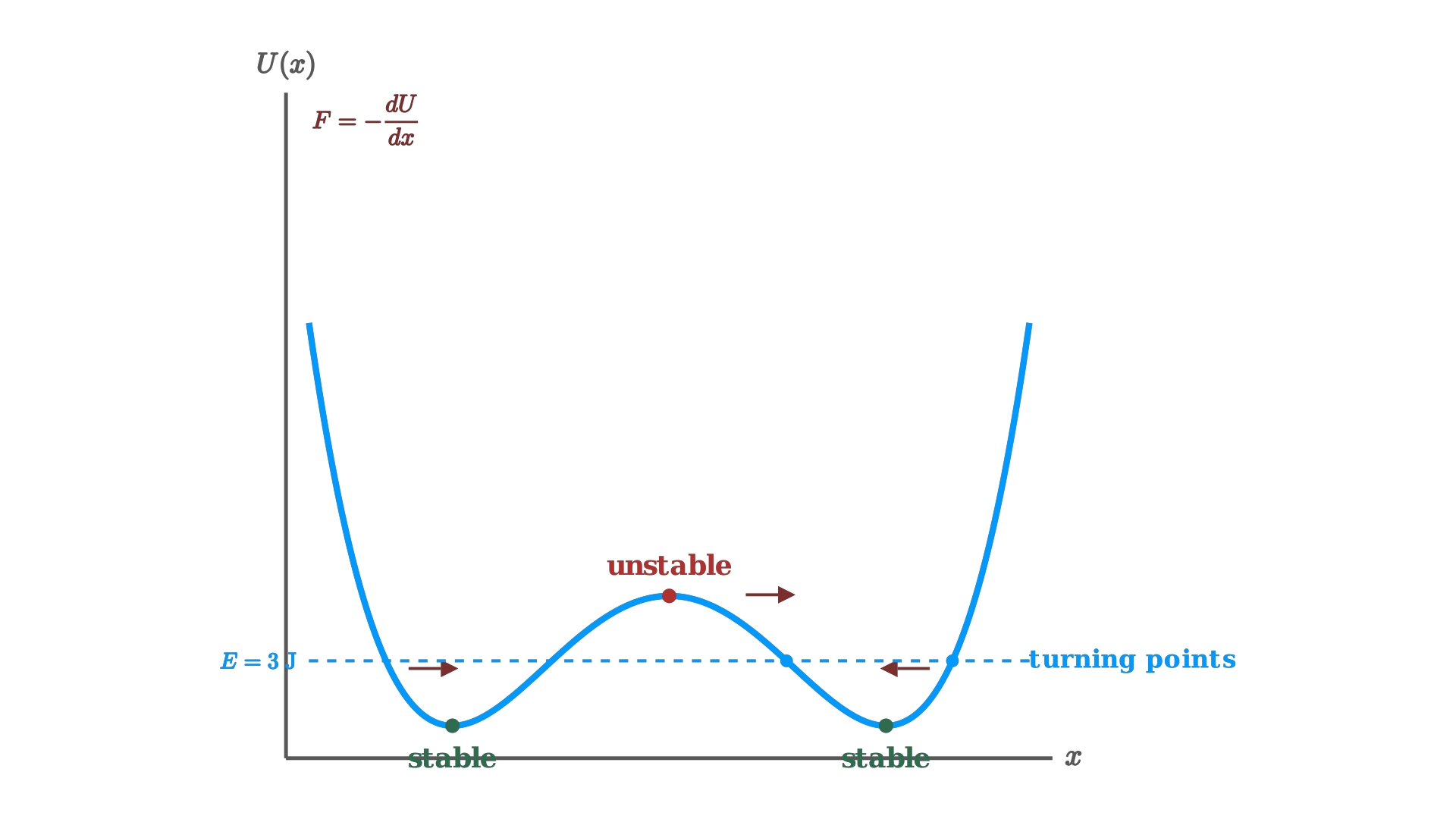
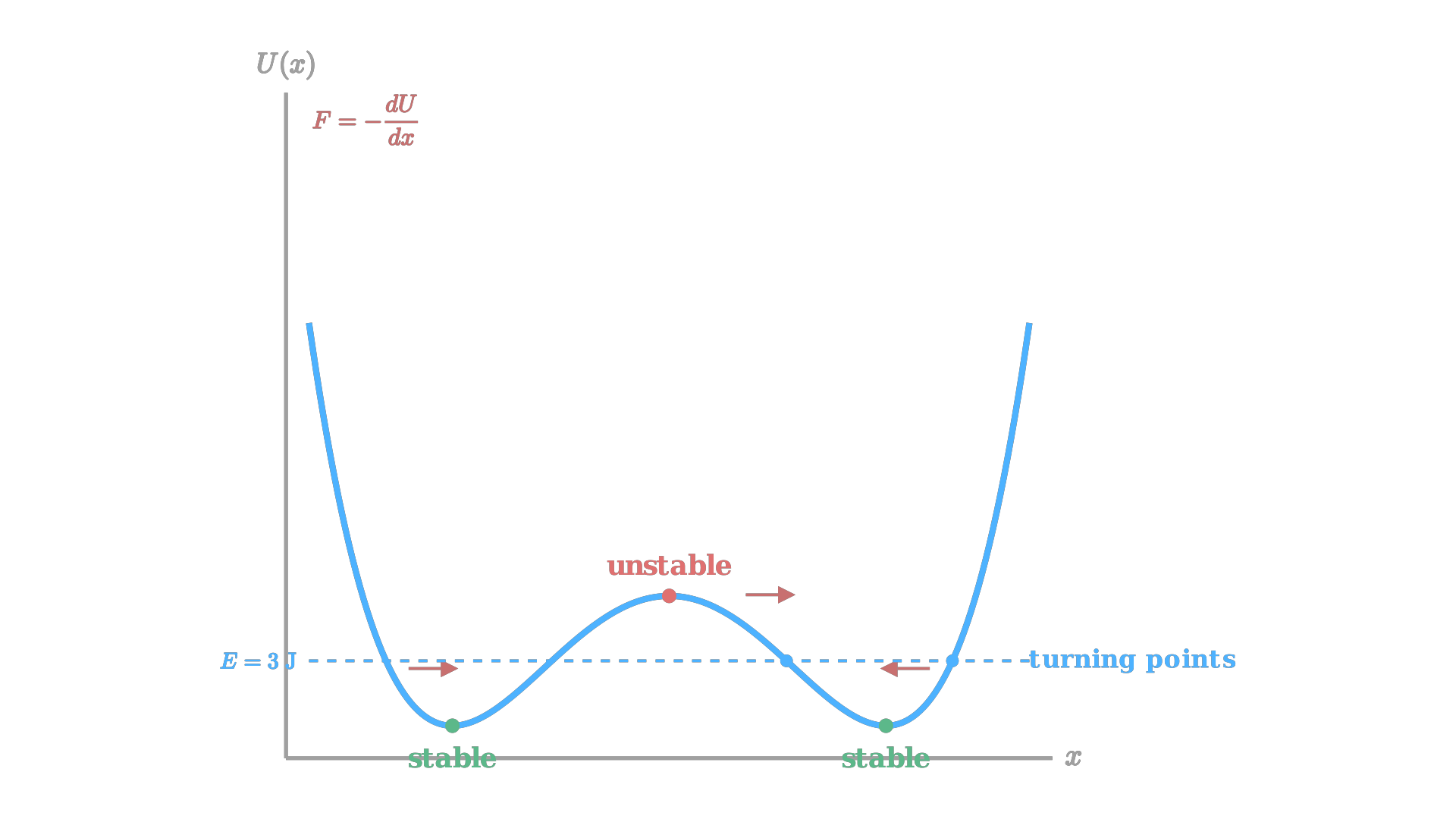
Stable and Unstable Equilibrium稳定平衡与不稳定平衡
At any position where $dU/dx = 0$, the force is zero and the system is in equilibrium. Stable equilibrium occurs at a local minimum (valleys): displaced objects get pushed back. Unstable equilibrium occurs at a local maximum (peaks): displaced objects get pushed away.
凡是 $dU/dx = 0$ 的位置,力为零,系统处于平衡(equilibrium)。在局部极小值(势能"谷底")处为稳定平衡(stable equilibrium):物体偏离后会被推回。在局部极大值(势能"顶峰")处为不稳定平衡(unstable equilibrium):物体偏离后会被推得更远。
At any position where the $U$-$x$ graph is flat (slope zero), the force is zero and the system is in equilibrium. Stable equilibrium occurs at a valley (local minimum) of the graph: a displaced object is pushed back. Unstable equilibrium occurs at a peak (local maximum): a displaced object is pushed further away.
凡是 $U$-$x$ 图像水平(斜率为零)的位置,力为零,系统处于平衡(equilibrium)。图像的"谷底"(局部极小)为稳定平衡(stable equilibrium):物体偏离后会被推回。"峰顶"(局部极大)为不稳定平衡(unstable equilibrium):物体偏离后会被推得更远。
A horizontal line drawn at the total energy $E$ meets the curve at the turning points, where $K = 0$; the vertical gap between that line and the curve is the kinetic energy.
在总能量 $E$ 处画一条水平线,它与曲线的交点就是转折点,那里 $K = 0$;水平线与曲线之间的竖直距离就是动能。
turning points)。Common Potential Energies常见势能形式
| Interaction相互作用 | Potential energy势能 | Where $U = 0$$U = 0$ 的位置 | Force it gives对应的力 |
|---|---|---|---|
| Gravity near Earth's surface近地表重力 | $U_g = mgy$ | any height you choose任选的高度 | $mg$ downward, constant$mg$,竖直向下,恒定 |
| Gravity between two masses两质量之间的引力 | $U_g = -\dfrac{Gm_1m_2}{r}$ | $r = \infty$ | $\dfrac{Gm_1m_2}{r^2}$, attractive$\dfrac{Gm_1m_2}{r^2}$,吸引 |
| Ideal spring理想弹簧 | $U_s = \tfrac{1}{2}k(\Delta x)^2$ | natural length自然长度 | $k|\Delta x|$, toward natural length$k|\Delta x|$,指向自然长度 |
Worked Example: Finding Speed from Potential Energy例题:由势能求速率
A spring ($k = 800$ N/m) compressed 0.15 m launches a 0.25 kg ball horizontally. Find the launch speed (ignore friction).
弹簧($k = 800$ N/m)被压缩 0.15 m,水平弹射一颗 0.25 kg 的球。求出射速率(忽略摩擦)。
// Conservation of energy: spring PE → kinetic energy
// 能量守恒:弹簧势能 → 动能
Worked Example: Force and Equilibrium from $U(x)$例题:由 $U(x)$ 求力与平衡 Physics C
A particle moves along $x$ with potential energy $U(x) = 3x^2 - x^3$ (J, with $x$ in m). (a) Find $F(x)$ and its value at $x = 1.0$ m. (b) Find and classify the equilibrium positions. (c) What minimum kinetic energy at $x = 0$ lets the particle pass $x = 2.0$ m?
一质点沿 $x$ 轴运动,势能为 $U(x) = 3x^2 - x^3$(单位 J,$x$ 以 m 计)。(a) 求 $F(x)$ 及其在 $x = 1.0$ m 处的值;(b) 求平衡位置并判断稳定性;(c) 质点在 $x = 0$ 处至少需要多少动能才能越过 $x = 2.0$ m?
Worked Example: Reading Force and Speed from a $U$-$x$ Graph例题:由 $U$-$x$ 图像读出力与速率
A $0.50\;\text{kg}$ particle has a $U$-$x$ graph made of straight segments: $U$ falls from $6.0\;\text{J}$ at $x = 0$ to $2.0\;\text{J}$ at $x = 2.0\;\text{m}$, stays at $2.0\;\text{J}$ until $x = 3.0\;\text{m}$, then rises to $8.0\;\text{J}$ at $x = 5.0\;\text{m}$. The particle is released from rest at $x = 0$. Find (a) the force in each region, (b) the speed at $x = 2.5\;\text{m}$, and (c) the right-hand turning point.
一个 $0.50\;\text{kg}$ 的质点,其 $U$-$x$ 图像由直线段组成:$U$ 从 $x = 0$ 处的 $6.0\;\text{J}$ 降到 $x = 2.0\;\text{m}$ 处的 $2.0\;\text{J}$,保持 $2.0\;\text{J}$ 直到 $x = 3.0\;\text{m}$,然后升到 $x = 5.0\;\text{m}$ 处的 $8.0\;\text{J}$。质点从 $x = 0$ 处静止释放。求 (a) 各区域中的力;(b) $x = 2.5\;\text{m}$ 处的速率;(c) 右侧转折点。
Before writing an energy equation, name the system and say where $U = 0$; only changes in $U$ are physical, so any zero works if you keep it for the whole problem.
写能量方程前,先说明所选系统以及 $U = 0$ 的位置;只有 $U$ 的变化有物理意义,只要整道题保持一致,零点可以任选。
On a $U$-$x$ graph question, take the force from the slope (with a minus sign) and the kinetic energy from the gap between the total-energy line $E$ and the curve; never read the force from the height of the curve.
遇到 $U$-$x$ 图像题,力由斜率(加负号)得到,动能由总能量线 $E$ 与曲线之间的差得到;绝不能用曲线的高度来读力。
Write $F_x = -dU/dx$ with its minus sign before differentiating, and when you classify an equilibrium, state the sign of $d^2U/dx^2$ (or the shape of the curve) as your reason.
求导前先写出带负号的 $F_x = -dU/dx$;判断平衡稳定性时,要把 $d^2U/dx^2$ 的符号(或曲线形状)作为理由写出来。
Why is it more accurate to say that the ball-Earth system has gravitational potential energy than to say that the ball has it?为什么说"球-地球系统具有重力势能"比说"球具有重力势能"更准确?
Potential energy comes from the interaction between objects. The gravitational force is an interaction between the ball and Earth, and the energy depends on their separation, so it is stored in the pair. A single isolated object has no potential energy.
势能来自物体之间的相互作用。重力是球与地球之间的相互作用,能量取决于两者的相对位置,因此储存在这一对物体组成的系统中。单独一个孤立物体没有势能。
A $0.50\;\text{kg}$ book is lifted from the floor to a shelf $1.2\;\text{m}$ higher. Find $\Delta U_g$. If you choose $U = 0$ at the shelf instead of the floor, what is $U$ on the floor, and does $\Delta U_g$ change?把 $0.50\;\text{kg}$ 的书从地面放到高 $1.2\;\text{m}$ 的书架上。求 $\Delta U_g$。若改取书架处 $U = 0$,地面处的 $U$ 是多少?$\Delta U_g$ 会变吗?
$\Delta U_g = mg\Delta y = (0.50)(9.8)(1.2) \approx 5.9\;\text{J}$. With $U = 0$ at the shelf, the floor has $U = -5.9\;\text{J}$, but the change from floor to shelf is still $+5.9\;\text{J}$: the reference shifts every value by the same amount.
$\Delta U_g = mg\Delta y = (0.50)(9.8)(1.2) \approx 5.9\;\text{J}$。取书架处 $U = 0$ 时,地面处 $U = -5.9\;\text{J}$,但从地面到书架的变化仍为 $+5.9\;\text{J}$:参考点只是把每个数值平移同样的量。
A spring with $k = 400\;\text{N/m}$ is compressed $5.0\;\text{cm}$. How much energy does it store, and how much more must be added to compress it to $10\;\text{cm}$?$k = 400\;\text{N/m}$ 的弹簧被压缩 $5.0\;\text{cm}$,储存多少能量?要把它压缩到 $10\;\text{cm}$,还需再输入多少能量?
$U_1 = \tfrac{1}{2}(400)(0.050)^2 = 0.50\;\text{J}$ and $U_2 = \tfrac{1}{2}(400)(0.10)^2 = 2.0\;\text{J}$, so $1.5\;\text{J}$ more is needed. Doubling the compression multiplies the stored energy by 4, because $U \propto x^2$.
$U_1 = \tfrac{1}{2}(400)(0.050)^2 = 0.50\;\text{J}$,$U_2 = \tfrac{1}{2}(400)(0.10)^2 = 2.0\;\text{J}$,所以还需 $1.5\;\text{J}$。压缩量加倍,储能变为 4 倍,因为 $U \propto x^2$。
At a certain point a $U$-$x$ graph slopes downward to the right with slope $-4.0\;\text{J/m}$. What is the force on the particle there?$U$-$x$ 图像在某点向右下方倾斜,斜率为 $-4.0\;\text{J/m}$。质点在该点受到的力是多少?
$F_x$ is minus the slope: $F_x = +4.0\;\text{N}$, pointing in the $+x$ direction, which is downhill on the graph toward lower $U$.
$F_x$ 等于斜率的相反数:$F_x = +4.0\;\text{N}$,指向 $+x$ 方向,也就是图像上指向 $U$ 较低的"下坡"方向。
(Physics C) A conservative force along $x$ is $F_x = -4.0x + 6.0x^2$ (N, with $x$ in m). Taking $U(0) = 0$, find $U(x)$ and $U(2.0\;\text{m})$.(Physics C)沿 $x$ 方向的保守力为 $F_x = -4.0x + 6.0x^2$(N,$x$ 以 m 计)。取 $U(0) = 0$,求 $U(x)$ 及 $U(2.0\;\text{m})$。
$U(x) = -\int_0^x F_x\,dx' = -\int_0^x (-4.0x' + 6.0x'^2)\,dx' = 2.0x^2 - 2.0x^3$ (J). At $x = 2.0\;\text{m}$: $U = 2.0(4.0) - 2.0(8.0) = 8.0 - 16 = -8.0\;\text{J}$. Check: $-dU/dx = -4.0x + 6.0x^2$ recovers the force.
$U(x) = -\int_0^x F_x\,dx' = -\int_0^x (-4.0x' + 6.0x'^2)\,dx' = 2.0x^2 - 2.0x^3$(J)。在 $x = 2.0\;\text{m}$ 处:$U = 2.0(4.0) - 2.0(8.0) = 8.0 - 16 = -8.0\;\text{J}$。检验:$-dU/dx = -4.0x + 6.0x^2$ 恰好还原出力。
Conservation of Energy能量守恒
- Define a system and decide whether its mechanical energy is conserved (no work by external forces and no internal nonconservative forces).
- Apply $K_i + U_i = K_f + U_f$ to calculate a speed, height or spring compression.
- Include the work of friction with $K_i + U_i + W_\text{nc} = K_f + U_f$, where $W_\text{nc} < 0$ for friction.
- Draw and interpret energy bar charts for the initial and final states of a system.
- Combine energy conservation with a force condition, such as the top of a vertical loop.
- 定义系统,并判断其机械能是否守恒(外力不做功且系统内部没有非保守力)。
- 应用 $K_i + U_i = K_f + U_f$ 计算速率、高度或弹簧压缩量。
- 用 $K_i + U_i + W_\text{nc} = K_f + U_f$ 计入摩擦力做的功(摩擦时 $W_\text{nc} < 0$)。
- 画出并解读系统初态与末态的能量条形图(
energy bar chart)。 - 把能量守恒与受力条件结合起来,例如竖直圆环的最高点。
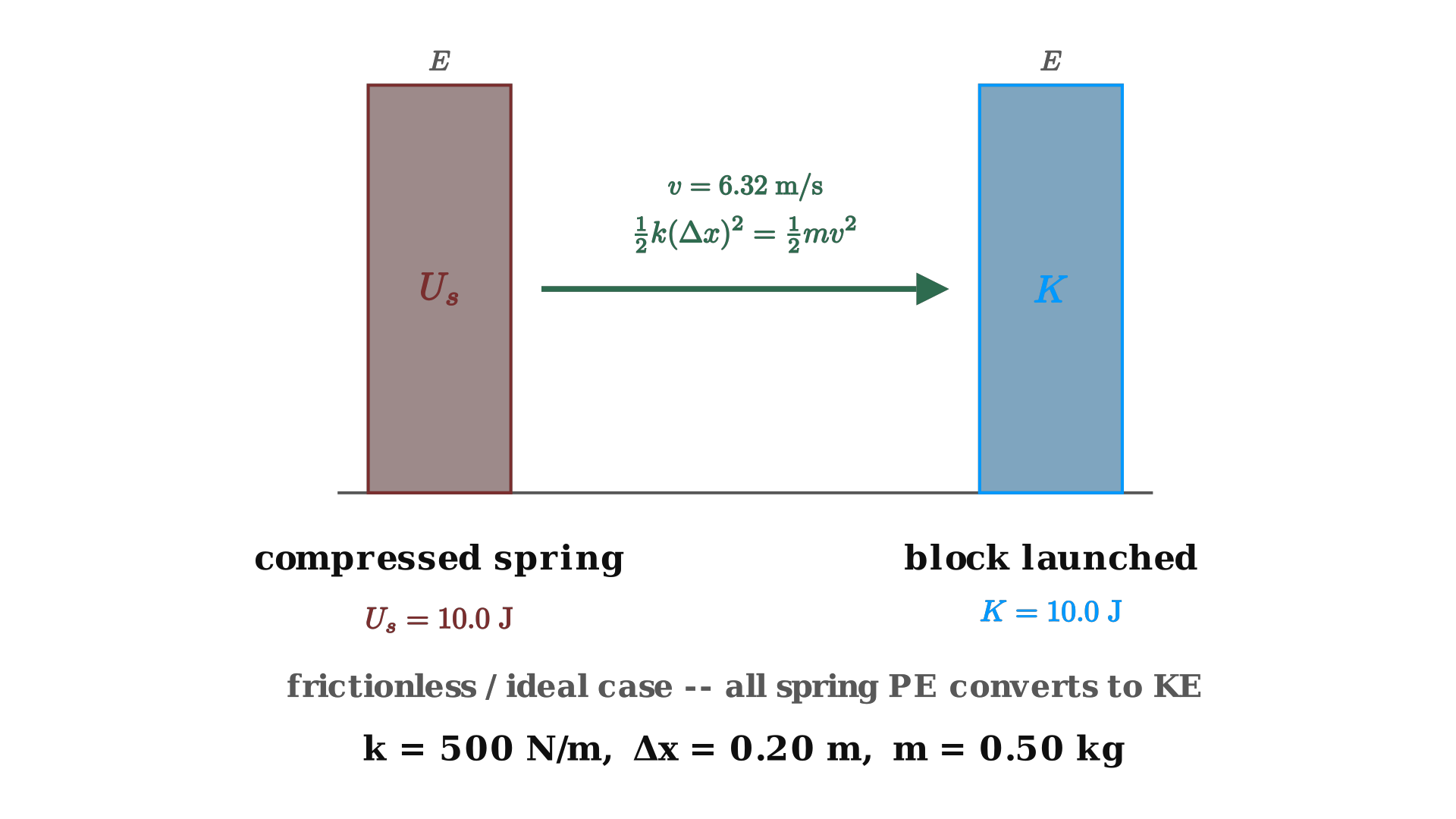
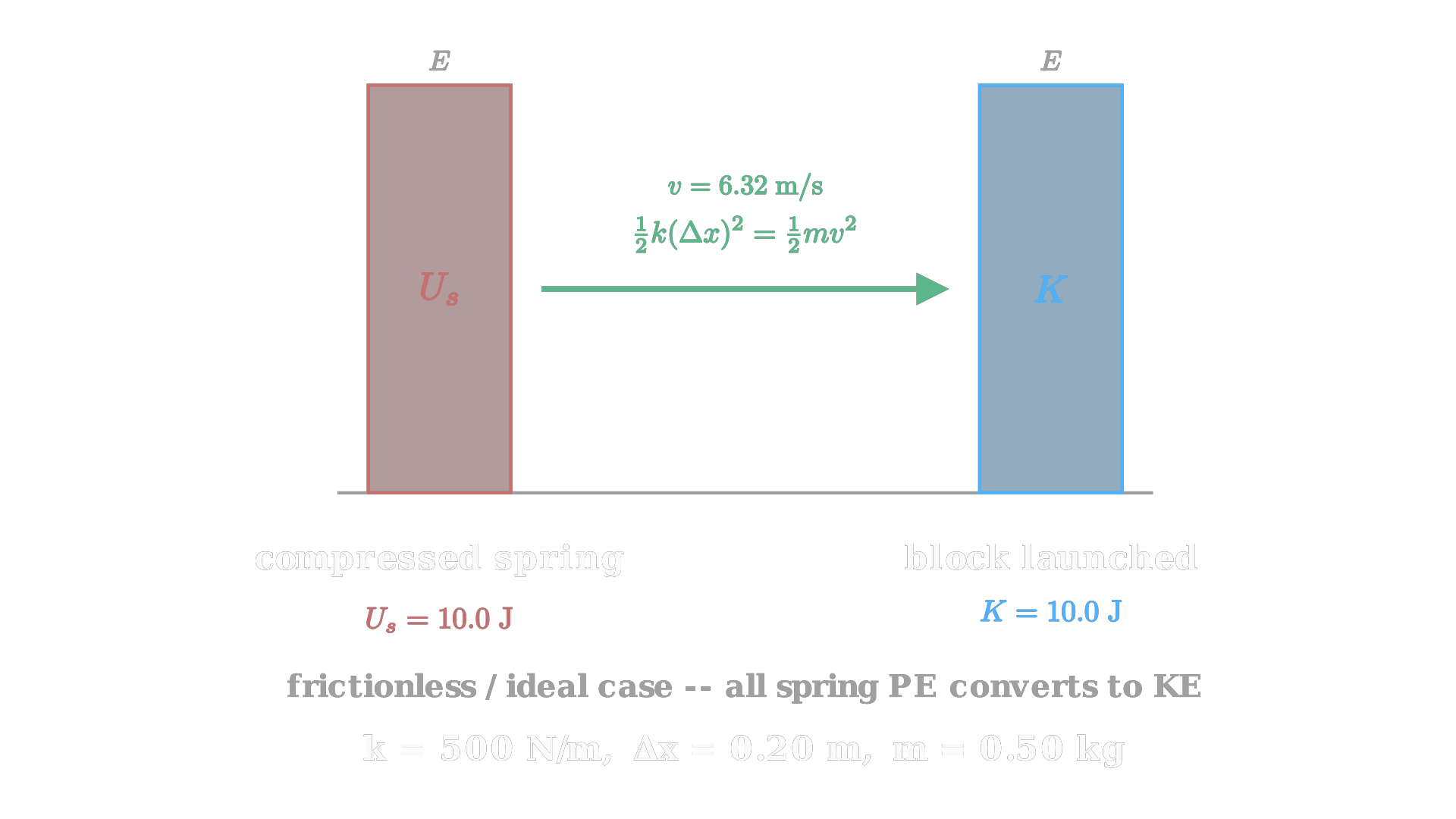
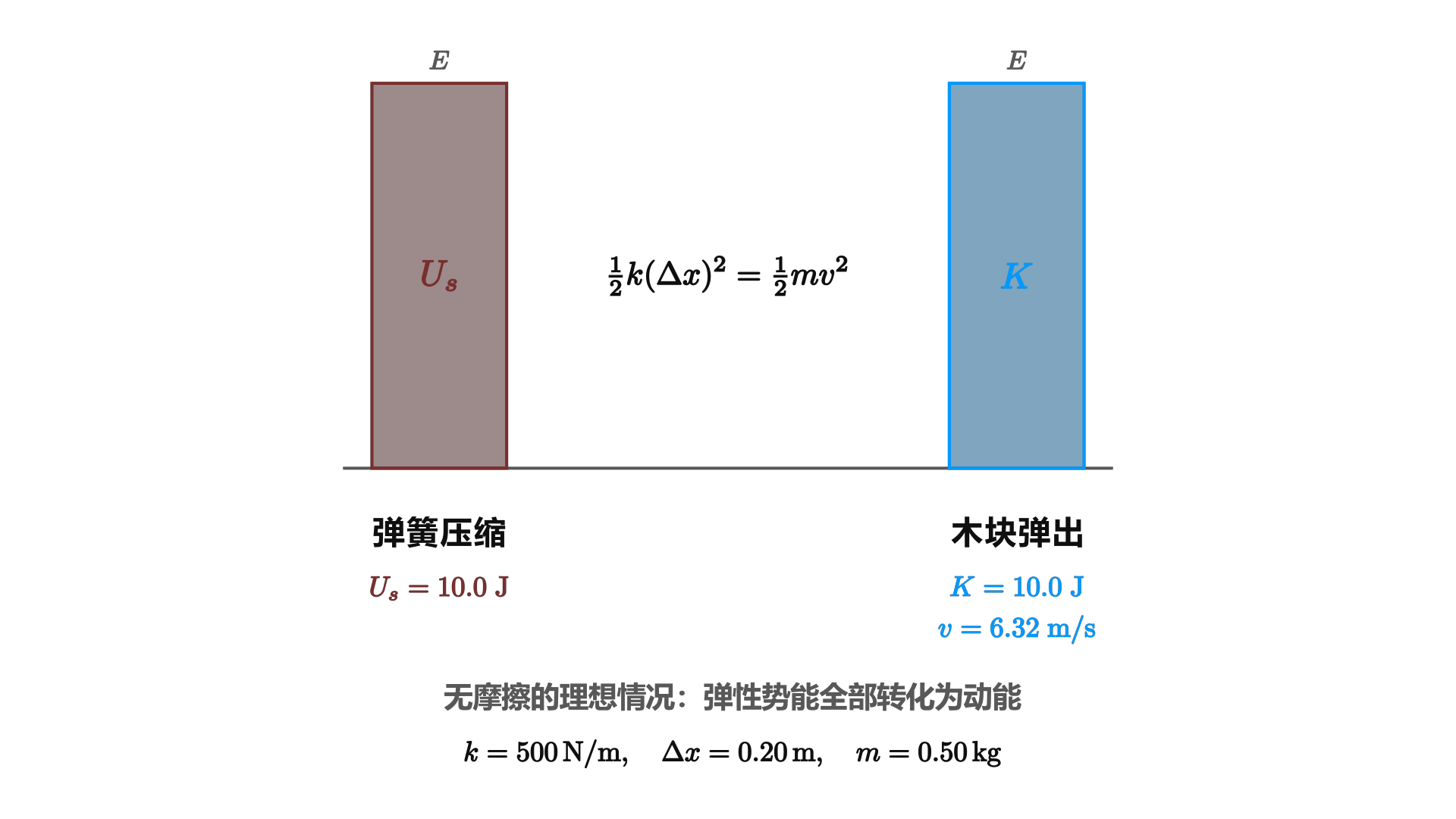
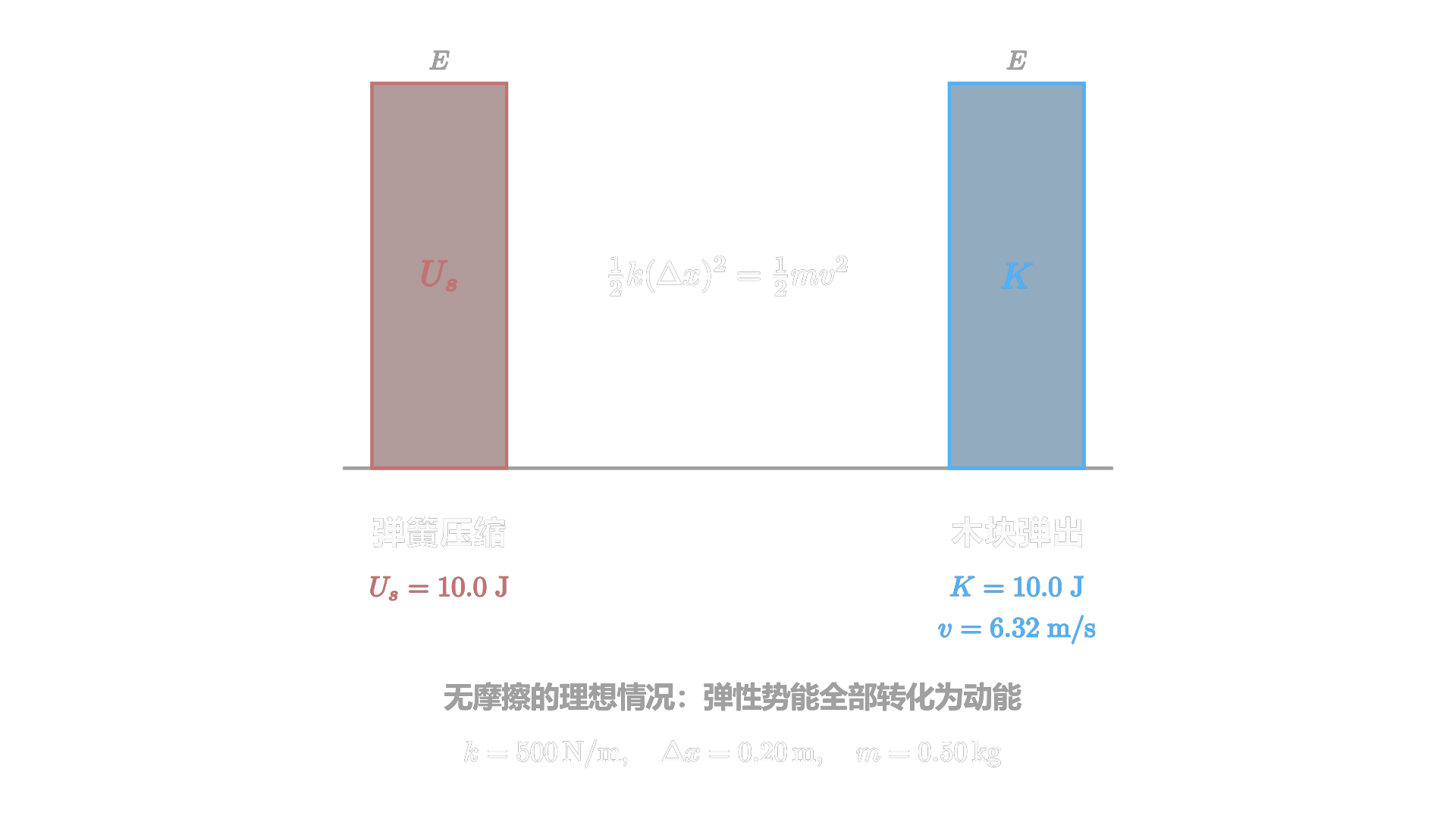
Energy conservation is one of the most profound principles in all of science. The total energy of an isolated system never changes: energy can be transformed and transferred, but never created or destroyed.
能量守恒(conservation of energy)是整个科学中最深刻的原理之一:孤立系统的总能量永远不变:能量只能转化或传递,不能被创生或毁灭。
In this unit we focus on mechanical energy: the sum of kinetic and potential energies. The conservation law takes different forms depending on your system choice:
本单元重点研究机械能(mechanical energy):动能与势能之和。守恒律的表达形式取决于系统的选取:
First Principles: Energy Conservation from the Work-Energy Theorem第一性原理:由动能定理推出能量守恒
Principle. The work-energy theorem: the net work by all forces equals the change in kinetic energy, $W_\text{net} = \Delta K$.
原理。动能定理:所有力所做的净功等于动能的变化,$W_\text{net} = \Delta K$。
- Split the forces into conservative and nonconservative: $W_\text{cons} + W_\text{nc} = \Delta K$.
- Each conservative force has a potential energy with $W_\text{cons} = -\Delta U$, so $-\Delta U + W_\text{nc} = \Delta K$.
- Rearrange: $W_\text{nc} = \Delta K + \Delta U = \Delta E_\text{mech}$, which is $K_i + U_i + W_\text{nc} = K_f + U_f$.
- 把力分为保守力与非保守力:$W_\text{cons} + W_\text{nc} = \Delta K$。
- 每个保守力都有势能,满足 $W_\text{cons} = -\Delta U$,所以 $-\Delta U + W_\text{nc} = \Delta K$。
- 整理得 $W_\text{nc} = \Delta K + \Delta U = \Delta E_\text{mech}$,即 $K_i + U_i + W_\text{nc} = K_f + U_f$。
Check. With $W_\text{nc} = 0$ the result is $K_i + U_i = K_f + U_f$. With friction alone, $W_\text{nc} = -F_f d$, so $E_\text{mech}$ can only fall, and it falls by more the longer the path. Units: every term is in joules.
检验。当 $W_\text{nc} = 0$ 时结果为 $K_i + U_i = K_f + U_f$。只有摩擦时 $W_\text{nc} = -F_f d$,所以 $E_\text{mech}$ 只会减少,路程越长减少越多。单位:每一项都是焦耳。
In the 1840s James Prescott Joule let falling weights turn a paddle wheel inside an insulated tank of water. The water warmed by an amount proportional to the work the weights did.
19 世纪 40 年代,James Prescott Joule 让下落的重物带动隔热水箱中的桨轮转动。水温升高的量与重物所做的功成正比。
His result, close to the modern 4.184 J per calorie, showed that the mechanical energy friction "loses" reappears as thermal energy. That is why total energy is conserved even when $E_\text{mech}$ is not.
他的结果接近现代值:每卡 4.184 J。这说明摩擦"损失"的机械能以热能的形式重新出现。正因如此,即使 $E_\text{mech}$ 不守恒,总能量仍然守恒。
Wikipedia: Mechanical equivalent of heat (Joule's apparatus and results)维基百科:热功当量(Joule 的装置与结果)
Energy with Nonconservative Forces含非保守力的能量
When nonconservative forces are present (typically friction), mechanical energy is not conserved: some converts to thermal energy:
当存在非保守力(通常是摩擦力)时,机械能不再守恒,其中一部分会转化为热能:
thermal energy)。初态能量加上 Wf 等于末态能量(196 − 50 = 146 kJ = 122.5 + 23.5 kJ);由 K 条的 ½mv² = 23.5 kJ 即可求出速率。Worked Example: Roller Coaster with Friction例题:含摩擦的过山车
A 500 kg coaster starts from rest at 40 m high, climbs a 25 m hill. 50,000 J lost to friction. Find speed at the second hill.
一辆 500 kg 的过山车从 40 m 高处静止释放,爬升到 25 m 高的另一座山顶。途中摩擦耗散 50,000 J。求其在第二座山顶处的速率。
Worked Example: Loop-the-Loop Minimum Release Height例题:竖直圆环轨道的最小释放高度
A small block is released from rest at height $h$ on a frictionless track that leads into a vertical loop of radius $R$. Find the minimum $h$ (in terms of $R$) for the block to maintain contact with the track at the top of the loop.
在光滑轨道上从高度 $h$ 处静止释放一个小滑块,轨道末端接一个半径为 $R$ 的竖直圆环。求滑块在圆环最高点仍能与轨道保持接触所需的最小 $h$(用 $R$ 表示)。
centripetal force):Worked Example: Bungee Jumper Maximum Stretch例题:蹦极的最大伸长
A 70 kg jumper steps off a platform attached to an ideal bungee cord of natural length $L_0 = 15$ m and spring constant $k = 200$ N/m. Use $g = 9.8$ m/s². Find the maximum stretch $\Delta x$ of the cord (the jumper momentarily at rest at the lowest point).
一名 70 kg 的蹦极者从平台跃下,绑着一根理想蹦极绳,自然长度 $L_0 = 15$ m,弹簧常数 $k = 200$ N/m。取 $g = 9.8$ m/s²。求蹦极绳的最大伸长 $\Delta x$(蹦极者在最低点瞬时静止)。
Before substituting numbers, write the energy equation in symbols for the two states you chose (for example $mgh_i + W_f = \tfrac{1}{2}mv_f^2 + mgh_f$) and say which terms are zero and why. If friction acts, its work is $-f_k d$ with $d$ the path length.
代入数字之前,先针对所选的两个状态写出符号形式的能量方程(例如 $mgh_i + W_f = \tfrac{1}{2}mv_f^2 + mgh_f$),并说明哪些项为零及原因。若有摩擦,其做功为 $-f_k d$,$d$ 为路程。
When a question gives or asks for an energy bar chart, check that the bars in each state add to the same total, after accounting for any work done by forces from outside the system. In gravity-only problems the mass usually cancels; cancel it symbolically and say so.
题目给出或要求画能量条形图时,检查每个状态的条形加起来是否相同(计入系统外力所做的功之后)。只有重力做功的问题中质量通常会约掉;要用符号把它约掉并写明。
A ball is thrown straight up and caught at the launch height. Ignoring air resistance, describe the energy bar chart of the ball-Earth system at launch, at the top, and just before the catch (take $U = 0$ at the launch height).竖直向上抛出一个球,并在抛出高度接住。忽略空气阻力,取抛出高度处 $U = 0$,描述球-地球系统在抛出时、最高点和接住前一刻的能量条形图。
At launch: one $K$ bar, $U = 0$. At the top: $K = 0$ and a $U$ bar equal in height to the launch $K$ bar. Just before the catch: the $K$ bar is back to its launch height and $U = 0$. The total is the same in all three states because no nonconservative force acts.
抛出时:只有 $K$ 条,$U = 0$。最高点:$K = 0$,$U$ 条与抛出时的 $K$ 条一样高。接住前一刻:$K$ 条恢复到抛出时的高度,$U = 0$。没有非保守力,所以三个状态的总能量相同。
A $0.20\;\text{kg}$ ball is dropped from rest $5.0\;\text{m}$ above the ground. Ignoring air resistance, find its speed just before it lands. Does the mass matter?$0.20\;\text{kg}$ 的球从离地 $5.0\;\text{m}$ 处静止释放。忽略空气阻力,求它落地前一刻的速率。质量有影响吗?
$mgh = \tfrac{1}{2}mv^2$, so $v = \sqrt{2gh} = \sqrt{2(9.8)(5.0)} = \sqrt{98} \approx 9.9\;\text{m/s}$. The mass cancels, so it does not matter.
$mgh = \tfrac{1}{2}mv^2$,所以 $v = \sqrt{2gh} = \sqrt{2(9.8)(5.0)} = \sqrt{98} \approx 9.9\;\text{m/s}$。质量约掉了,因此没有影响。
A $60\;\text{kg}$ skier starts from rest at the top of a slope $20\;\text{m}$ high and reaches the bottom at $15\;\text{m/s}$. How much mechanical energy was dissipated? If the path along the slope is $100\;\text{m}$ long, what was the average resistive force?$60\;\text{kg}$ 的滑雪者从高 $20\;\text{m}$ 的坡顶静止出发,到达坡底时速率为 $15\;\text{m/s}$。耗散了多少机械能?若沿坡路程为 $100\;\text{m}$,平均阻力是多少?
$U_i = mgh = (60)(9.8)(20) = 11{,}760\;\text{J}$ and $K_f = \tfrac{1}{2}(60)(15)^2 = 6750\;\text{J}$, so $5010\;\text{J} \approx 5.0\;\text{kJ}$ was dissipated. Average resistive force: $f = 5010/100 \approx 50\;\text{N}$.
$U_i = mgh = (60)(9.8)(20) = 11{,}760\;\text{J}$,$K_f = \tfrac{1}{2}(60)(15)^2 = 6750\;\text{J}$,所以耗散了 $5010\;\text{J} \approx 5.0\;\text{kJ}$。平均阻力:$f = 5010/100 \approx 50\;\text{N}$。
Power功率
- Calculate average power $P_\text{avg} = W/\Delta t$ in watts.
- Calculate instantaneous power $P = Fv\cos\theta$ for a force acting on a moving object.
- Explain why a vehicle moving at constant speed still needs power to overcome drag or to climb a slope.
- Determine a top speed from the condition that engine power equals the power dissipated by resistive forces.
- Use $P = dW/dt$ to relate power and work, and integrate $v(t)$ to find the distance travelled at constant power.
- 以瓦特(
W)为单位计算平均功率 $P_\text{avg} = W/\Delta t$。 - 计算作用于运动物体的力的瞬时功率 $P = Fv\cos\theta$。
- 解释为什么匀速行驶的车辆仍需要功率来克服阻力或爬坡。
- 由"发动机功率等于阻力耗散功率"的条件确定最高速度。
- 用 $P = dW/dt$ 联系功率与功,并对 $v(t)$ 积分求恒功率下的行驶距离。
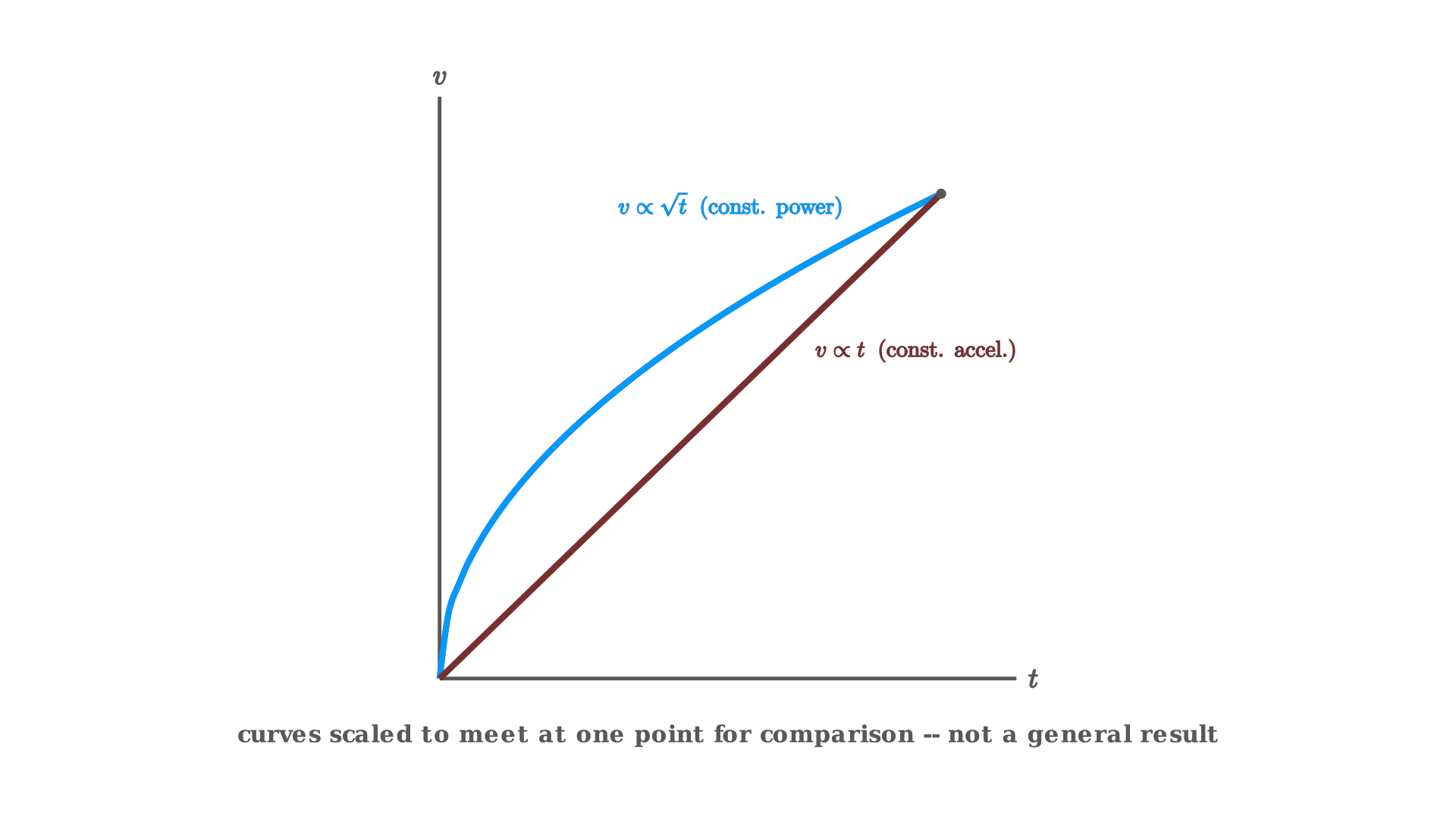
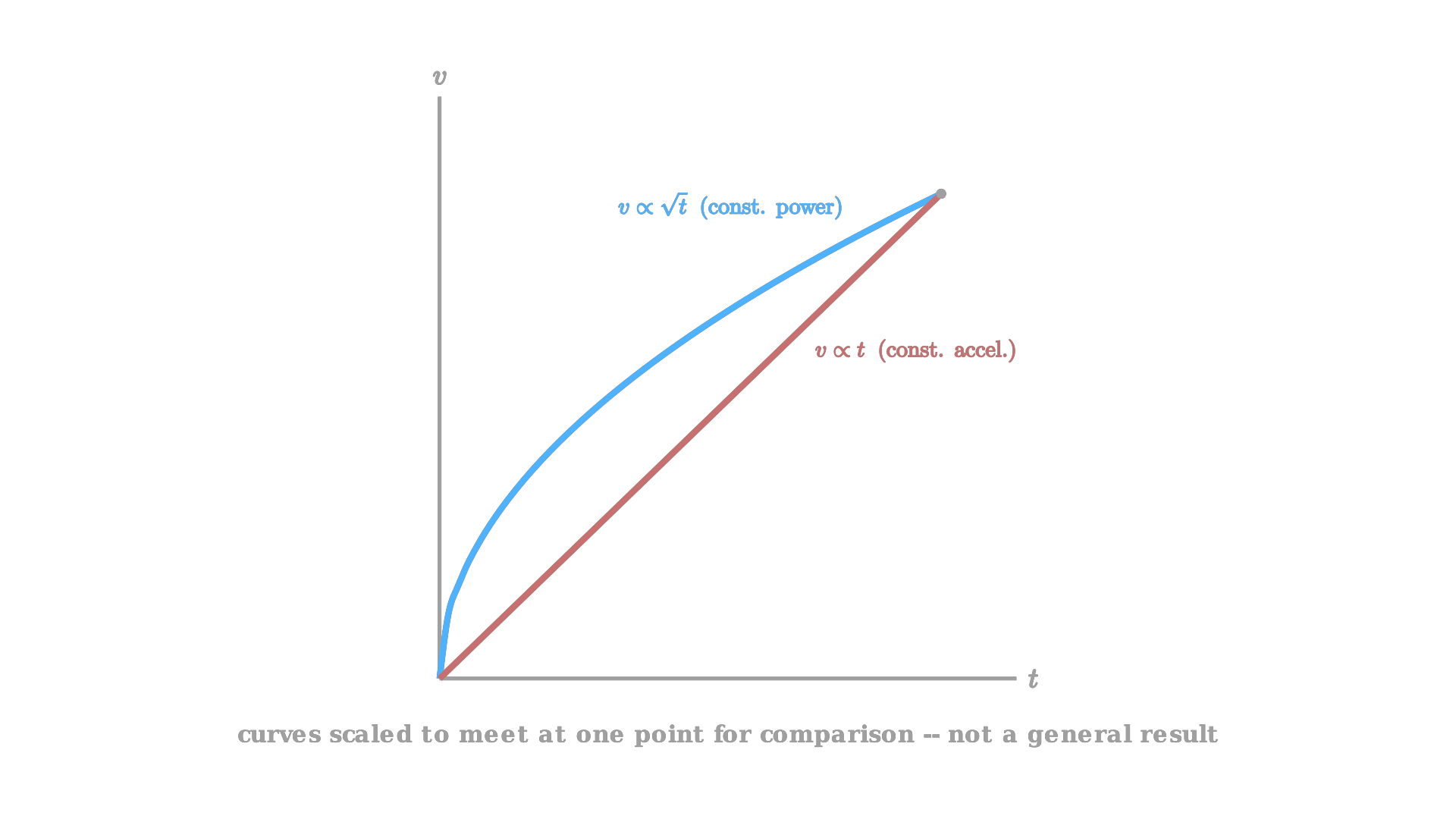
Power measures how quickly energy is transferred or converted. Two machines might do the same total work, but the faster one delivers more power. The SI unit is the Watt (W = J/s). One horsepower ≈ 746 W.
功率(power)衡量能量被传递或转化的快慢。两台机器即使做的总功相同,做得更快的那台输出更大的功率。SI 单位是瓦特(Watt,W = J/s)。一马力 ≈ 746 W。
A particularly useful derived formula connects power directly to force and velocity:
下面这条派生公式特别有用,它把功率直接与力和速度联系起来:
First Principles: Why $P = Fv\cos\theta$第一性原理:为什么 $P = Fv\cos\theta$
Principle. Power is the rate of doing work, and a force does work $F\cos\theta$ times each bit of displacement.
原理。功率是做功的快慢,而力在每一小段位移上做的功等于 $F\cos\theta$ 乘以该位移。
- In time $dt$ the object moves $d\vec{r}$, so $dW = \vec{F}\cdot d\vec{r}$.
- Divide by $dt$: $P = \dfrac{dW}{dt} = \vec{F}\cdot\dfrac{d\vec{r}}{dt}$.
- Since $d\vec{r}/dt = \vec{v}$, $P = \vec{F}\cdot\vec{v} = Fv\cos\theta$.
- 在时间 $dt$ 内物体移动 $d\vec{r}$,所以 $dW = \vec{F}\cdot d\vec{r}$。
- 两边除以 $dt$:$P = \dfrac{dW}{dt} = \vec{F}\cdot\dfrac{d\vec{r}}{dt}$。
- 由于 $d\vec{r}/dt = \vec{v}$,$P = \vec{F}\cdot\vec{v} = Fv\cos\theta$。
- Over a short time $\Delta t$ the object moves $\Delta x$, so the force does $W = F\cos\theta\,\Delta x$.
- Divide by the time: $P = \dfrac{W}{\Delta t} = F\cos\theta\,\dfrac{\Delta x}{\Delta t}$.
- Over a short enough interval, $\Delta x/\Delta t$ is the speed $v$, so $P = Fv\cos\theta$.
- 在很短的时间 $\Delta t$ 内物体移动 $\Delta x$,力做功 $W = F\cos\theta\,\Delta x$。
- 除以时间:$P = \dfrac{W}{\Delta t} = F\cos\theta\,\dfrac{\Delta x}{\Delta t}$。
- 时间间隔足够短时,$\Delta x/\Delta t$ 就是速率 $v$,所以 $P = Fv\cos\theta$。
Check. Holding a weight still ($v = 0$) gives $P = 0$: no work is done on the weight. A force perpendicular to the motion ($\theta = 90^{\circ}$) also gives $P = 0$. Units: $\text{N}\cdot\text{m/s} = \text{J/s} = \text{W}$.
检验。把重物静止举着($v = 0$)时 $P = 0$:没有对重物做功。与运动方向垂直的力($\theta = 90^{\circ}$)同样给出 $P = 0$。单位:$\text{N}\cdot\text{m/s} = \text{J/s} = \text{W}$。
terminal velocity)下,合外力为零,动能不变。驱动力的全部功率都被阻力耗散。常见模型:$P_\text{engine} = F_\text{drag} \cdot v_\text{terminal}$。
Worked Example: Constant-Speed Car with a Constant Resistive Force (P = F·v)例题:恒定阻力下匀速行驶的汽车(P = F·v)
A car of mass $m = 1200$ kg cruises at a constant $v = 25$ m/s on a level road against a constant resistive force of $600$ N. (a) Find the engine force and power needed. (b) If the engine can deliver at most $P_\text{max} = 24$ kW, find the car's top speed against the same resistive force.
质量 $m = 1200$ kg 的汽车在平直公路上以恒定 $v = 25$ m/s 匀速行驶,所受阻力恒为 $600$ N。(a) 求所需的发动机力与功率;(b) 若发动机最大功率 $P_\text{max} = 24$ kW,求在相同阻力下的最高速度。
Worked Example: Car vs. Quadratic Drag (P = F·v, FRQ-style)例题:汽车与二次阻力(P = F·v,FRQ 风格) Physics C
A car of mass $m = 1200$ kg cruises on a level road. Aerodynamic drag is $F_\text{drag} = bv^2$ with $b = 0.80\;\text{N}\cdot\text{s}^2/\text{m}^2$. The engine delivers force $F_\text{eng}$ at the drive wheels.
质量 $m = 1200$ kg 的汽车在平直公路上匀速行驶,空气阻力(aerodynamic drag)$F_\text{drag} = bv^2$,其中 $b = 0.80\;\text{N}\cdot\text{s}^2/\text{m}^2$。发动机在驱动轮上提供力 $F_\text{eng}$。
(a) Find the engine force and power needed to cruise at a constant $v = 30$ m/s. (b) If the engine can deliver at most $P_\text{max} = 60$ kW, find the car's top speed. (c) At top speed, what is the instantaneous acceleration if the engine force is suddenly doubled (drag unchanged)?
(a) 求保持 $v = 30$ m/s 匀速所需的发动机力与功率;(b) 若发动机最大功率 $P_\text{max} = 60$ kW,求最高时速;(c) 在最高速时,若发动机力突然加倍(阻力不变),瞬时加速度是多少?
Takeaway: $P = \vec{F}\cdot\vec{v}$ connects engine output, the drag law, and top speed: each part of this FRQ is one line once you identify which quantity is constant.
要点:$P = \vec{F}\cdot\vec{v}$ 把发动机输出、阻力定律与最高时速串了起来,只要先看清哪个量恒定,FRQ 的每一小题都只是一行计算。
Worked Example: Power Delivered by a Car Engine例题:汽车发动机的瞬时功率
A 1400 kg car accelerates from rest with constant net force 5000 N. What is the instantaneous power at $t = 4$ s?
1400 kg 的汽车以恒定合力 5000 N 从静止加速。$t = 4$ s 时的瞬时功率是多少?
Worked Example: Constant-Power Acceleration (Calculus)例题:恒功率加速(微积分) Physics C
An engine delivers a constant 60 kW of power to a 1500 kg car starting from rest on a level frictionless road. Find (a) the speed at $t = 8.0$ s and (b) the distance covered in that time.
发动机以恒定 60 kW 功率驱动 1500 kg 的汽车,从静止在平直无摩擦的路面上加速。求 (a) $t = 8.0$ s 时的速率;(b) 这段时间内行驶的距离。
A watt is a joule per second: convert kW to W and minutes to seconds before dividing. For a vehicle at constant speed, the engine force equals the total resistive force (drag, friction, and $mg\sin\theta$ on a slope), so $P = F_\text{eng}v$ even though $\Delta K = 0$.
瓦特就是焦耳每秒:相除之前先把 kW 换成 W、分钟换成秒。车辆匀速行驶时,发动机的力等于总阻力(空气阻力、摩擦力,以及坡道上的 $mg\sin\theta$),所以即使 $\Delta K = 0$,仍有 $P = F_\text{eng}v$。
Use $P = W/\Delta t$ for an average over an interval and $P = Fv$ for one instant, and say which one the question asks for.
一段时间内的平均值用 $P = W/\Delta t$,某一瞬间用 $P = Fv$,并写明题目问的是哪一种。
For a constant-power problem, start from $P = dW/dt$ (so $W = Pt$) or from $P = Fv = mv\,dv/dt$ and separate variables; write the integral with its limits before evaluating it.
恒功率问题从 $P = dW/dt$(因此 $W = Pt$)或 $P = Fv = mv\,dv/dt$ 出发并分离变量;求值前先写出带上下限的积分。
A car moves at constant velocity on a level road, so its kinetic energy is constant. Why must the engine still deliver power?汽车在平直公路上匀速行驶,动能不变。为什么发动机仍需输出功率?
Air drag and rolling friction do negative work on the car all the time. The engine does an equal amount of positive work each second to replace that energy, so the net work and $\Delta K$ are zero while the engine's power is $P = F_\text{resist}v$.
空气阻力和滚动摩擦一直对汽车做负功。发动机每秒做等量的正功来补充这部分能量,因此净功和 $\Delta K$ 为零,而发动机的功率为 $P = F_\text{resist}v$。
A motor lifts a $50\;\text{kg}$ load at a constant $2.0\;\text{m/s}$. What power does it deliver?电动机以恒定的 $2.0\;\text{m/s}$ 提升 $50\;\text{kg}$ 的重物。它输出的功率是多少?
At constant speed the lifting force equals the weight: $F = mg = (50)(9.8) = 490\;\text{N}$. Then $P = Fv = (490)(2.0) = 980\;\text{W}$.
匀速时提升力等于重力:$F = mg = (50)(9.8) = 490\;\text{N}$。于是 $P = Fv = (490)(2.0) = 980\;\text{W}$。
Two students climb the same $4.0\;\text{m}$ flight of stairs. Student A ($60\;\text{kg}$) takes $5.0\;\text{s}$; student B ($80\;\text{kg}$) takes $8.0\;\text{s}$. Who develops more average power?两名学生登上同一段高 $4.0\;\text{m}$ 的楼梯。学生 A($60\;\text{kg}$)用时 $5.0\;\text{s}$;学生 B($80\;\text{kg}$)用时 $8.0\;\text{s}$。谁的平均功率更大?
$P_A = mgh/\Delta t = (60)(9.8)(4.0)/5.0 \approx 470\;\text{W}$ and $P_B = (80)(9.8)(4.0)/8.0 \approx 392\;\text{W}$. Student B does more work ($3136\;\text{J}$ versus $2352\;\text{J}$) but student A develops more power, because power is the rate.
$P_A = mgh/\Delta t = (60)(9.8)(4.0)/5.0 \approx 470\;\text{W}$,$P_B = (80)(9.8)(4.0)/8.0 \approx 392\;\text{W}$。学生 B 做的功更多($3136\;\text{J}$ 对 $2352\;\text{J}$),但学生 A 的功率更大,因为功率是做功的快慢。
Exam Strategy考试策略
Multiple Choice)Practise comparing kinetic energies through the $v^2$ dependence, finding the sign of work from the force-displacement angle, reading $U(x)$ graphs for equilibrium and turning points, and applying conservation to two-state problems.
练习:利用 $v^2$ 关系比较动能;由力与位移的夹角判断做功正负;从 $U(x)$ 图像找出平衡位置与转折点;对"两态"问题应用守恒律。
Be ready to interpret an integral or derivative physically (work as an area, force as minus a slope), and to decide quickly whether energy methods or Newton's laws are shorter.
要能说出积分或导数的物理意义(功是面积,力是斜率的相反数),并迅速判断能量方法与 Newton 定律哪个更简短。
From May 2027 the AP Physics C: Mechanics exam has 42 multiple-choice questions in 85 minutes (50% of the score); Unit 3 is 15-25% of the multiple-choice section.
自 2027 年 5 月起,AP Physics C: Mechanics 考试有 42 道选择题,用时 85 分钟(占总分 50%);第 3 单元占选择题部分的 15-25%。
Practise comparing kinetic energies through the $v^2$ dependence, finding the sign of work from the force-displacement angle, reading $U$-$x$ graphs by slope for equilibrium and turning points, finding work as the area under a force-position graph, and applying conservation to two-state problems with energy bar charts.
练习:利用 $v^2$ 关系比较动能;由力与位移的夹角判断做功正负;用斜率从 $U$-$x$ 图像找出平衡位置与转折点;把功求为力-位置图像下的面积;借助能量条形图对"两态"问题应用守恒律。
Decide quickly whether energy methods or Newton's laws are shorter.
迅速判断能量方法与 Newton 定律哪个更简短。
From May 2027 the AP Physics 1 exam has 42 multiple-choice questions in 85 minutes (50% of the score); Unit 3 is 18-23% of the multiple-choice section.
自 2027 年 5 月起,AP Physics 1 考试有 42 道选择题,用时 85 分钟(占总分 50%);第 3 单元占选择题部分的 18-23%。
Free-Response Question)From May 2027, Section II has 4 free-response questions in 95 minutes (50% of the score), one of each type: mathematical routines; translation between representations; experimental design and analysis; qualitative/quantitative translation.
自 2027 年 5 月起,第二部分有 4 道自由作答题,用时 95 分钟(占总分 50%),四种题型各一道:数学过程(mathematical routines);不同表征之间的转换(translation between representations);实验设计与分析(experimental design and analysis);定性/定量转换(qualitative/quantitative translation)。
Energy ideas fit all four: practise deriving symbolic expressions (for example, the speed at the bottom of a ramp), justifying whether a force is conservative, sketching $K$, $U$ and $E$ against position, drawing energy bar charts, and writing a coherent paragraph-length explanation.
能量概念适用于这四种题型:练习推导符号表达式(如滑下斜面后底端的速率)、说明某个力是否保守、画 $K$、$U$、$E$ 随位置变化的图像、画能量条形图,并写一段连贯的分析。
Show every calculus step: write the integral with its limits, or the derivative, before evaluating it, so the method is visible and not only the result.
把每一步微积分都写出来:求值前先写出带上下限的积分或导数,让方法本身可见,而不只是结果。
Show every step: write the energy equation in symbols first, then substitute numbers with units, so the method is visible and not only the result.
把每一步都写出来:先写出符号形式的能量方程,再代入带单位的数字,让方法本身可见,而不只是结果。
Common Mistakes常见错误
1. Confusing force and energy on $U(x)$ graphs. Force is the negative slope of $U(x)$, not $U$ itself.
2. Forgetting the negative sign in $F = -dU/dx$. Without it, forces point uphill instead of downhill.
2. Forgetting the minus sign when reading force from a $U$-$x$ graph. The force is minus the slope: if $U$ rises to the right, the force points left.
3. Using displacement instead of path length for friction. Friction dissipates energy proportional to total distance, not net displacement.
4. Applying $\Delta U_g = mg\Delta h$ at planetary scales. This only works near Earth's surface. For orbits, use $U = -Gm_1m_2/r$.
5. Forgetting to square velocity in KE. Writing $K = \frac{1}{2}mv$ instead of $\frac{1}{2}mv^2$ is fatal.
6. Confusing power and work. Work is total energy transferred; power is the rate.
7. Inconsistent $U = 0$ reference. The choice is arbitrary, but you must be consistent throughout the problem.
1. 在 $U(x)$ 图上把力和能量混淆。力是 $U(x)$ 的负斜率,不是 $U$ 本身。
2. 在 $F = -dU/dx$ 中漏掉负号。漏了负号,力就指向"上坡"而非"下坡"。
2. 从 $U$-$x$ 图像读力时漏掉负号。力等于斜率的相反数:若 $U$ 向右升高,力指向左。
3. 摩擦力计算用位移而非路程。摩擦耗散的能量正比于总路程,不是净位移。
4. 在行星尺度上仍用 $\Delta U_g = mg\Delta h$。该式只在近地表成立。轨道问题要用 $U = -Gm_1m_2/r$。
5. 动能漏掉速度的平方。写成 $K = \frac{1}{2}mv$ 而不是 $\frac{1}{2}mv^2$,直接送命。
6. 把功率(power)和功(work)混为一谈。功是总传递能量,功率是变化率。
7. $U = 0$ 参考点不一致。参考点可以任选,但整道题必须前后统一。
Flashcards闪卡
Click a card to flip it.
点击卡片可翻面。
Unit Quiz单元测验
Unit Quiz: Questions 5 to 8单元测验:第 5 至 8 题
Worked Example: Variable Force, $U(x)$ and Turning Points (FRQ Style)例题:变力、$U(x)$ 与转折点(FRQ 风格) Physics C
A particle of mass $m = 0.50\;\text{kg}$ moves along the $x$-axis under a conservative force whose potential energy is $U(x) = x^4 - 8x^2 + 5\;\text{J}$ (with $x$ in metres). The particle is released from rest at $x = 3.0\;\text{m}$.
质量 $m = 0.50\;\text{kg}$ 的质点沿 $x$ 轴在保守力作用下运动,势能为 $U(x) = x^4 - 8x^2 + 5\;\text{J}$($x$ 以米为单位)。该质点从 $x = 3.0\;\text{m}$ 处静止释放。
(a) Find the force $F(x)$. (b) Locate every equilibrium of $U(x)$ and classify each as stable or unstable. (c) Find the speed of the particle as it passes through $x = 0$. (d) Determine the turning points of the subsequent motion.
(a) 求力 $F(x)$;(b) 找出 $U(x)$ 的全部平衡位置并判断其稳定性;(c) 求经过 $x = 0$ 时的速率;(d) 找出之后运动的转折点。
Principle: for a conservative 1-D system, $F(x) = -dU/dx$, equilibria are roots of $dU/dx = 0$ classified by the sign of $d^2U/dx^2$, and energy conservation $E = K + U$ gives speed at any $x$ and turning points at $U(x) = E$.
原理:一维保守系统中,$F(x) = -dU/dx$;平衡位置是 $dU/dx = 0$ 的根,再由 $d^2U/dx^2$ 的符号判定稳定性;能量守恒 $E = K + U$ 给出任意 $x$ 处的速率,转折点满足 $U(x) = E$。
Compute the total energy $E$ once at the release point: it is conserved, so the same value gives speed at any $x$ and the locations of the turning points.
在释放点算一次总能量 $E$:它守恒,可直接用于任意 $x$ 处的速率与转折点位置。
double well)形态。Worked Example: Spring → Ramp → Friction (Energy Bookkeeping, FRQ Style)例题:弹簧 → 斜面 → 摩擦(能量记账,FRQ 风格)
A spring with $k = 800\;\text{N/m}$ is compressed by $\Delta x = 0.20\;\text{m}$ on a horizontal frictionless surface. When released, it launches a $m = 2.0\;\text{kg}$ block, which then slides without changing speed onto a ramp inclined at $\theta = 30^{\circ}$ with kinetic-friction coefficient $\mu_k = 0.25$ and static-friction coefficient $\mu_s = 0.30$.
$k = 800\;\text{N/m}$ 的弹簧在水平无摩擦表面上被压缩 $\Delta x = 0.20\;\text{m}$。释放后将 $m = 2.0\;\text{kg}$ 的木块弹出,木块随后速率不变地滑上倾角 $\theta = 30^{\circ}$ 的斜面,斜面的动摩擦系数 $\mu_k = 0.25$、静摩擦系数 $\mu_s = 0.30$。
(a) Find the launch speed. (b) Find the maximum distance $L$ the block slides up the inclined section before momentarily stopping. (c) Determine whether the block slides back down on its own. Use $g = 9.8\;\text{m/s}^2$.
(a) 求出射速率;(b) 求木块在斜面上瞬时静止前滑行的最大距离 $L$;(c) 判断木块此后是否会自动滑回。取 $g = 9.8\;\text{m/s}^2$。
Principle: energy conservation with non-conservative work: spring PE converts entirely to KE on the frictionless launch zone, then KE converts to gravitational PE plus heat as friction acts up the ramp. Resting condition compares the gravity component along the slope to the maximum static friction.
原理:含非保守功的能量守恒:在无摩擦发射段,弹簧势能完全转化为动能;在含摩擦的斜面段,动能转化为重力势能加上摩擦生成的热。是否会滑回则比较沿斜面的重力分量与最大静摩擦。
Energy conservation across the launch (spring → KE) and across the slide up the ramp (KE → gravitational PE + heat from friction):
分两段写能量方程:发射段(弹簧 → 动能)与上滑段(动能 → 重力势能 + 摩擦热):